Kathmandu is one of the most culturally dense cities on Earth. Within a single valley, you will find ancient temples, sacred stupas, royal palaces, and living traditions that have continued uninterrupted for over a thousand years. It is no surprise that the world took notice.
In 1979, UNESCO inscribed the Kathmandu Valley as a World Heritage Site — recognising it as one of the most extraordinary concentrations of cultural monuments anywhere in Asia. The designation covers seven distinct monument zones, each representing a different layer of Nepal's Hindu and Buddhist heritage.
- UNESCO inscription year: 1979
- Number of monument zones: 7
- Location: Kathmandu Valley, Bagmati Province, Nepal
- Significance: Outstanding universal value — Hindu and Buddhist cultural heritage
- Often called: The "City of Temples."
Whether you are planning a visit or simply want to understand why Kathmandu matters to the world, this guide covers everything you need to know about the UNESCO World Heritage Sites in Kathmandu Valley.
What Is the Kathmandu Valley UNESCO World Heritage Site?
The Kathmandu Valley UNESCO World Heritage Site is a collective designation covering seven groups of monuments and buildings across the Kathmandu Valley. It was inscribed on the UNESCO World Heritage List in 1979 under criteria that recognise outstanding cultural and artistic achievement.
The inscription acknowledges the valley's unique position as a living crossroads of Hindu and Buddhist civilisation. Unlike many purely historical heritage sites, Kathmandu's monuments are still actively used for worship, ceremony, and daily spiritual life by local communities.
- Official name: Kathmandu Valley World Heritage Site
- UNESCO inscription date: 1979
- Heritage type: Cultural
- Country: Federal Democratic Republic of Nepal
- Governing body: Department of Archaeology, Government of Nepal
The Kathmandu Valley UNESCO World Heritage Site is not a single location — it is a network of seven distinct monument zones spread across three historic cities: Kathmandu, Patan (Lalitpur), and Bhaktapur.
When Was Kathmandu Valley Listed by UNESCO?
The Kathmandu Valley was inscribed as a UNESCO World Heritage Site in 1979. It was among the earliest UNESCO inscriptions in Asia and remains one of the most significant cultural heritage designations on the continent.
The date of inscription — 1979 — places the Kathmandu Valley recognition in the very first years of the World Heritage Convention, which was adopted in 1972. Nepal was among the early nations to nominate sites of outstanding universal value.
- UNESCO World Heritage Convention adopted: 1972
- Kathmandu Valley UNESCO inscription year: 1979
- One of the first Asian sites inscribed under the convention
- The designation covers monuments from the 5th century onwards
- Inscription criteria: Cultural significance, architectural achievement, living heritage
The 7 UNESCO World Heritage Sites in Kathmandu Valley
The Kathmandu Valley UNESCO World Heritage Site covers seven monument zones. Each represents a distinct religious, architectural, or royal tradition within the valley's history.
- Swayambhunath (Monkey Temple)
- Boudhanath Stupa
- Pashupatinath Temple
- Kathmandu Durbar Square (Hanuman Dhoka)
- Patan Durbar Square
- Bhaktapur Durbar Square
- Changu Narayan Temple
Together, these seven UNESCO sites in Kathmandu Valley represent more than 1,500 years of continuous architectural and spiritual tradition. No other valley of comparable size anywhere in the world contains a comparable density of living cultural monuments.
Detailed Overview of Each UNESCO Site in Kathmandu
Swayambhunath — The Monkey Temple
Swayambhunath is one of the oldest religious monuments in Nepal, dating back at least to the 5th century. Perched on a hilltop west of Kathmandu city, it is visible from across the valley — its white dome and golden spire rising above the urban spread below.
The stupa is sacred to both Buddhists and Hindus, making it one of the most inclusive religious sites in all of Nepal. The complex includes the main stupa, several smaller shrines, a Tibetan monastery, and dozens of prayer wheels lining the approach steps.
- Swayambhunath stupa height: approximately 36 metres (dome and spire combined)
- The hilltop elevation above the valley floor: approximately 77 metres
- The 365 stone steps leading to the top represent one step for each day of the year
- Named "Monkey Temple" for the sacred monkeys that inhabit the complex
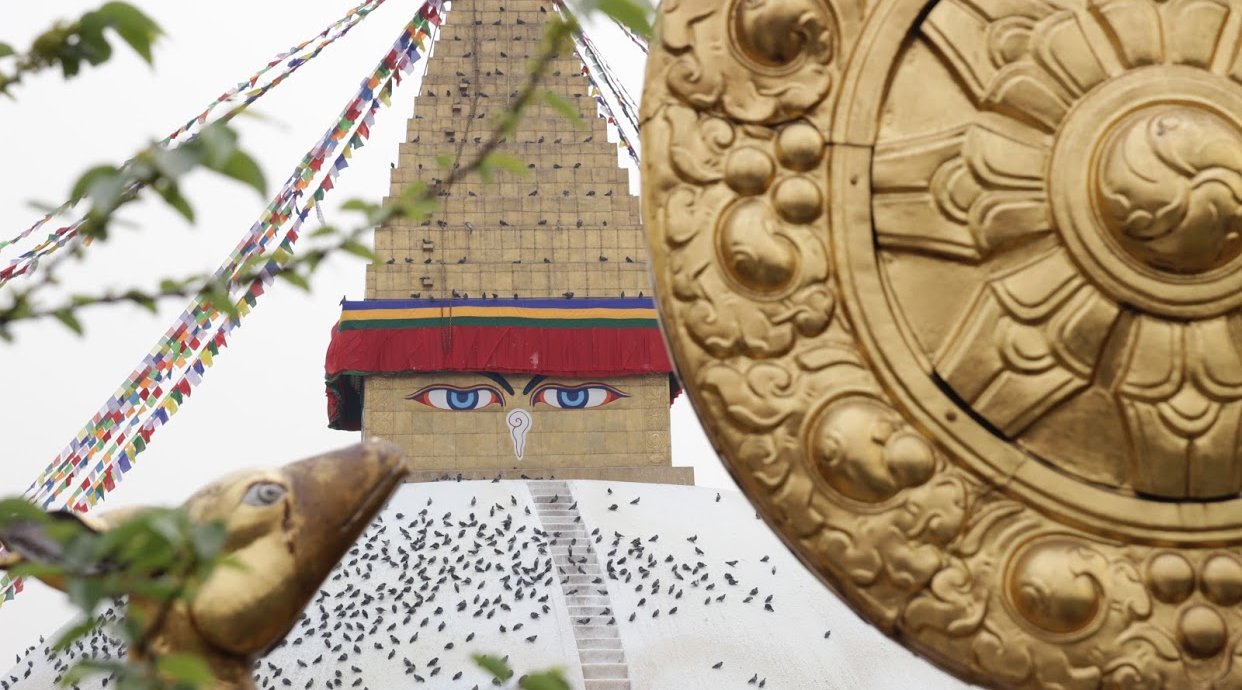
- The all-seeing eyes painted on the four sides of the spire are one of Nepal's most iconic images
The panoramic view of Kathmandu Valley from the top of Swayambhunath at sunrise is one of the most recommended experiences in the entire city.
Boudhanath Stupa — The Great Stupa of Kathmandu
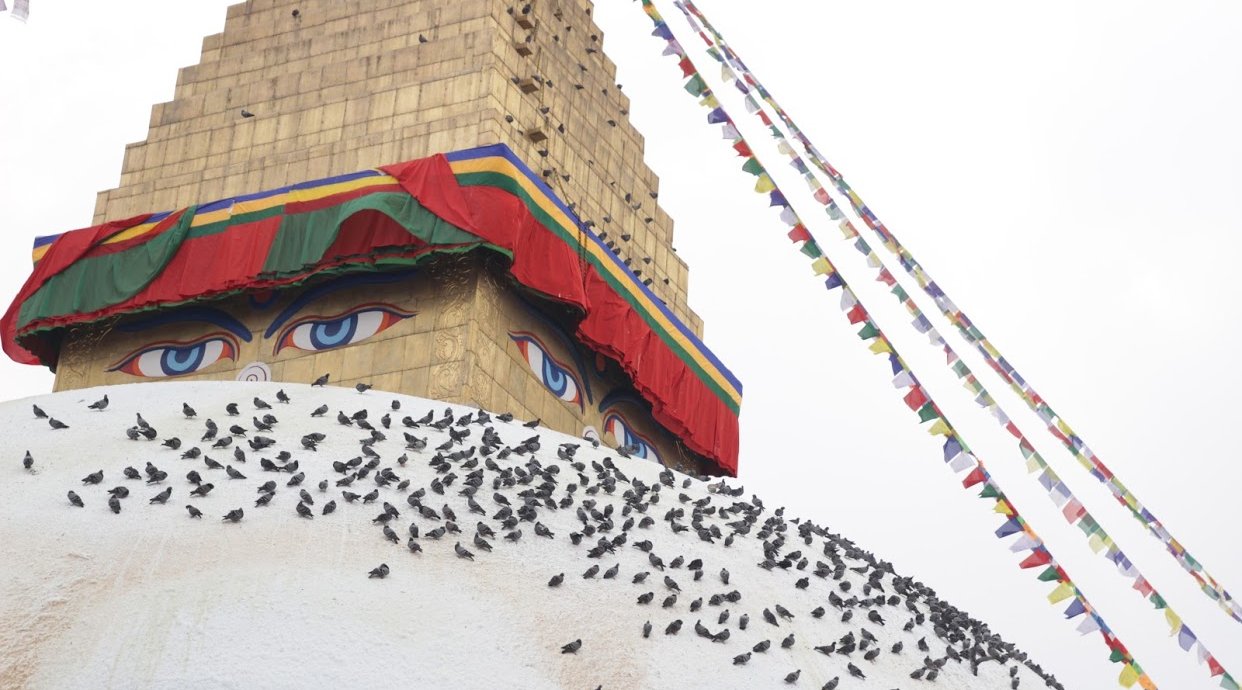
Boudhanath is the largest stupa in Nepal and one of the largest Buddhist stupas in the world. Located on the eastern outskirts of Kathmandu city, it has served as a major pilgrimage site for Tibetan Buddhists for centuries and remains the spiritual centre of the Tibetan diaspora community in Nepal today.
The scale of Boudhanath is immediately impressive. The mandala-shaped base, the massive white dome, and the painted eyes of the Buddha watching in all four directions create an atmosphere that is unlike any other religious site in Nepal.
- Boudhanath stupa height: approximately 36 metres
- The base circumference: approximately 100 metres
- The stupa is surrounded by over 50 Tibetan Buddhist monasteries (gompas)
- Boudhanath was significantly damaged in the 2015 earthquake and has since been fully restored
- UNESCO status: Inscribed as part of the Kathmandu Valley World Heritage Site in 1979
The circular kora (circumambulation path) around Boudhanath is walked daily by thousands of devotees, monks, and visitors. The atmosphere in the early morning and at dusk — with butter lamps lit and monks chanting — is extraordinary.
Pashupatinath Temple — Sacred to Shiva
Pashupatinath is the most sacred Hindu temple in Nepal and one of the holiest Shiva temples in the world. Situated on the banks of the Bagmati River in eastern Kathmandu, it draws hundreds of thousands of Hindu pilgrims annually from Nepal and India.
The main temple, built in the pagoda style with a distinctive two-tiered golden roof, dates to the 5th century in its current form — though the site's sacred history is considerably older. Non-Hindu visitors are not permitted inside the main temple but can observe the complex and its rituals from the eastern bank of the Bagmati.
- Main deity: Lord Pashupatinath — a form of Lord Shiva
- Architectural style: Nepalese pagoda with golden roof and silver doorways
- Location: Deopatan, on the banks of the Bagmati River
- Sacred cremation ghats: Visible from the opposite riverbank — an important ritual site
- Annual festival: Maha Shivaratri draws over 500,000 pilgrims each year
The ghats along the Bagmati River at Pashupatinath are where many Hindus of Nepal and India choose to be cremated — making this simultaneously one of the most sacred and most profound places in the country.
Kathmandu Durbar Square — Hanuman Dhoka
Kathmandu Durbar Square — also known as Hanuman Dhoka after the royal palace at its centre — was the seat of the ancient Malla and Shah kings of Kathmandu. The square contains a remarkable collection of temples, courtyards, and royal buildings spanning several centuries of construction.
The centrepiece is the Hanuman Dhoka palace complex, named after the stone statue of Hanuman that guards the main entrance. The square also contains the Kumari Ghar — the residence of Nepal's Living Goddess — and the Taleju Temple, one of the most architecturally significant pagoda temples in the valley.
- Location: Heart of old Kathmandu city
- Key structures: Hanuman Dhoka palace, Taleju Temple, Kumari Ghar, Kasthamandap
- Kasthamandap: The wooden pavilion that gave Kathmandu its name — believed to be built from a single tree
- Significantly damaged in the 2015 earthquake — restoration work ongoing
- Kumari Ghar: Home to the Kumari, a young girl revered as a living goddess in Nepali tradition
The square remains a living public space — ceremonies, festivals, and daily rituals continue here as they have for centuries, making it one of the most authentic heritage environments in all of South Asia.
Patan Durbar Square — City of Fine Arts
Patan, also known as Lalitpur (City of Fine Arts), contains what many architects and historians consider the finest collection of Newari craftsmanship in the world. Patan Durbar Square is extraordinarily well-preserved and its density of temples, courtyards, and carved wooden architecture is genuinely breathtaking.
The square was the royal centre of the Patan kingdom during the Malla period and contains the Royal Palace of Patan, the Golden Temple (Hiranya Varna Mahavihar), and dozens of pagoda temples in various states of beautiful antiquity.
- Location: Centre of Patan (Lalitpur), south of Kathmandu
- Architectural style: Newari — stone, brick, and carved wood construction
- Patan Museum: One of the finest museums in South Asia, housed in the restored royal palace
- Less crowded than Kathmandu Durbar Square — often preferred by visitors for atmosphere
- Largely undamaged in the 2015 earthquake — considered the best-preserved of the three Durbar Squares
Bhaktapur Durbar Square — The Medieval City
Bhaktapur is the most intact of the three historic cities in the Kathmandu Valley. Located 13 kilometres east of Kathmandu, it retains the atmosphere of a medieval Newari city more completely than any other settlement in Nepal. Cars are restricted in the old town and the brick-paved streets, wood-carved windows, and pottery squares create an environment that feels genuinely removed from the 21st century.
Bhaktapur Durbar Square anchors the city's heritage zone, containing the 55-Window Palace, Nyatapola Temple, and the famous Golden Gate — considered one of the finest examples of metalwork in Asia.
- Location: 13 km east of Kathmandu — accessible by bus or taxi
- Entry fee: Foreign visitors pay a heritage conservation fee to enter the old city
- Nyatapola Temple: The tallest pagoda temple in Nepal at five storeys
- 55-Window Palace: Named for its intricately carved window facade on the main courtyard
- Pottery Square (Talako Tol): A working pottery community producing traditional Newari ceramics
Bhaktapur is the most photogenic of the three Durbar Square cities and the most rewarding for visitors who want to spend a full day rather than a few hours.
Changu Narayan Temple — The Oldest Monument
Changu Narayan is the oldest monument among the seven UNESCO sites in Kathmandu Valley and one of the oldest temples in Nepal. Dedicated to Lord Vishnu, it sits on a forested hilltop in Bhaktapur district and contains stone carvings and inscriptions dating back to the 4th and 5th centuries.
The temple is less visited than the other six sites, which makes it all the more rewarding for those who make the journey. The surrounding hilltop village retains a quiet, traditional character and the views across the valley are among the finest available from any of the heritage sites.
- Deity: Lord Changu Narayan — a form of Lord Vishnu
- Oldest inscription: A 5th-century stone pillar inscription from King Manadeva I — the oldest dated inscription in Nepal
- Location: Changu hilltop, Bhaktapur district — approximately 22 km from Kathmandu
- Architectural period: Licchavi dynasty (4th–9th century AD)
- Least visited of the 7 UNESCO sites — ideal for travellers seeking a quieter experience
Key Facts About the Kathmandu Valley UNESCO Heritage Sites
- UNESCO inscription year: 1979
- Total monument zones: 7
- Cities covered: Kathmandu, Patan (Lalitpur), and Bhaktapur
- Swayambhunath stupa height: approximately 36 metres
- Boudhanath stupa height: approximately 36 metres
- Tallest pagoda temple: Nyatapola, Bhaktapur — five storeys
- Oldest site: Changu Narayan — inscriptions dating to the 5th century
- Active religious sites: All 7 monuments are still in daily religious use
- 2015 earthquake impact: Several sites damaged — most have since been restored
Why UNESCO Inscribed the Kathmandu Valley in 1979
The Kathmandu Valley UNESCO World Heritage Site was inscribed based on its outstanding universal value across multiple criteria.
The valley represents the pinnacle of Newari architecture — a building tradition unique to Nepal that combines Hindu and Buddhist visual culture in carved wood, brick, and stone. The density of monuments — major temples, royal palaces, and sacred sites within a valley of just 570 square kilometres — is unmatched anywhere in Asia.
- Religious significance: The valley is simultaneously sacred to Hindus and Buddhists — a living interfaith heritage landscape
- Architectural achievement: Newari pagoda architecture influenced temple building across the Himalayan region
- Historical continuity: Monuments span the Licchavi, Malla, and Shah dynasties — over 1,500 years of unbroken cultural tradition
- Living heritage: Unlike many inscribed sites, all seven monument zones are still actively used for religious practice
The UNESCO World Heritage Centre described the Kathmandu Valley as a place of outstanding universal value — a designation that recognises not just the physical monuments but the living culture that gives them meaning.
Travel and Visitor Information
Best Time to Visit The best time to visit the UNESCO heritage sites in Kathmandu is from October to December and from March to May. October and November offer clear skies, pleasant temperatures, and the famous autumn light that photographers travel from around the world to capture. March and April bring spring blooms and the vibrant colours of Holi and other spring festivals.
- October–December: Best weather, clear Himalayan views, major festival season
- March–May: Spring festivals, warmer temperatures, rhododendron blooms
- Monsoon (June–August): Heavy rain, reduced visibility, slippery stone courtyards
- Winter (December–February): Cold mornings, fewer crowds, excellent clarity
Practical Tips for Visitors
- Dress modestly at all religious sites — shoulders and knees covered
- Remove shoes before entering temples — carry a bag for footwear
- Photography restrictions vary by site — always check before shooting inside shrines
- Hire a licensed local guide for context — the stories behind each monument are as important as the monuments themselves
- Bhaktapur charges a heritage entry fee — budget accordingly
- Early morning visits are recommended — most sites are quieter and more atmospheric before 9 AM
Kathmandu — The City of Temples
Kathmandu has been called the City of Temples for centuries — and the seven UNESCO sites in the Kathmandu Valley are the reason why. But the heritage does not stop at the boundary of the inscribed zones.
The broader valley contains hundreds of smaller temples, water shrines (hiti), Buddhist viharas, and hilltop sanctuaries that together form one of the densest cultural landscapes in Asia. Every neighbourhood in the old city has its own local deity, its own annual festival, and its own architectural traditions.
This living quality is what makes Kathmandu's cultural heritage different from most UNESCO sites. These are not monuments preserved in glass cases. They are places where people pray, celebrate, mourn, and gather — as they have for a thousand years and more.
Conclusion
The Kathmandu Valley UNESCO World Heritage Site represents something rare: a place where history, architecture, and living culture exist together without contradiction. The seven heritage sites in Kathmandu Valley — from the great stupa of Boudhanath to the ancient carvings of Changu Narayan — tell the story of a civilisation that built extraordinary things and never stopped using them.
Inscribed by UNESCO in 1979, the Kathmandu Valley was among the first Asian sites to receive this recognition — and more than four decades later, it remains one of the most visited and most significant cultural heritage destinations in South Asia.
If you visit Nepal, the UNESCO sites in Kathmandu are not optional additions to your itinerary. They are the reason the itinerary exists.