Island Peak climbing represents the perfect introduction to Himalayan mountaineering. Rising to 6,189 meters in the heart of the Khumbu region, this stunning summit offers technical climbing experience without extreme expedition-level commitment.
The peak earned its English name from the 1953 British Everest expedition, who observed that it resembles an island rising from a sea of ice when viewed from Dingboche. Its official Nepali name, Imja Tse, reflects its position above the Imja Glacier.
Why Island Peak Stands Out:
- Classified as an NMA "trekking peak" — accessible with basic mountaineering skills
- Alpine grade PD+ (moderately difficult) — challenging but achievable
- Spectacular summit views of Lhotse, Makalu, Ama Dablam, and Baruntse
- 70-90% success rate with proper preparation and guidance
- Ideal first 6,000-meter peak for aspiring mountaineers
This 12-day Island Peak climbing itinerary follows the direct route via Chhukung, focusing entirely on the climb itself with strategic acclimatization days built into the schedule.
The route passes through legendary Sherpa villages, ancient Buddhist monasteries, and some of the most dramatic mountain scenery on Earth before reaching the technical climbing sections above base camp.
Day-by-Day Itinerary with Highlights
| Day |
Route & Altitude |
Highlights |
| Day 1 |
Kathmandu → Lukla → Phakding (2,610m) |
Scenic mountain flight to Lukla; first views of Khumbu peaks; gentle riverside trail |
| Day 2 |
Phakding → Namche Bazaar (3,440m) |
Hillary Suspension Bridge; National Park entry; steep climb with first Everest views |
| Day 3 |
Acclimatization in Namche Bazaar |
Rest day; optional hike to Everest View Hotel (3,880m); explore Sherpa capital |
| Day 4 |
Namche → Tengboche (3,860m) |
Stunning Ama Dablam panoramas; visit Tengboche Monastery (largest in Khumbu) |
| Day 5 |
Tengboche → Dingboche (4,410m) |
Rhododendron forest; high-altitude desert transition; first Island Peak views |
| Day 6 |
Acclimatization in Dingboche |
Critical rest; optional hike to 5,000m+; gear check and summit briefing |
| Day 7 |
Dingboche → Chhukung (4,730m) |
Short trek to final village; Lhotse views; final preparations; early sleep |
| Day 8 |
Chhukung → Base Camp (5,200m) |
Cross rough moraine; expedition camping begins; summit briefing; 7 PM bedtime |
| Day 9 |
SUMMIT DAY (6,189m) |
Pre-dawn start; glacier crossing; headwall ascent; summit ridge; 360° panorama |
| Day 10 |
Chhukung → Namche (3,440m) |
Long descent; celebration dinner; breathe easier at lower altitude |
| Day 11 |
Namche → Lukla (2,840m) |
Final trek day; farewell dinner with team; rest before flight |
| Day 12 |
Lukla → Kathmandu |
Morning flight; trip concludes; day free |
Why Island Peak Is One of Nepal's Best First Climbing Peaks
For mountaineers seeking their first genuine Himalayan summit, Island Peak climbing offers an unmatched combination of accessibility and authentic alpine challenge.
Unlike purely "walk-up" peaks, Island Peak requires real technical skills: fixed rope ascent, crampon technique, and glacier travel. Yet the difficulties remain manageable for physically fit trekkers willing to learn.
What Makes Island Peak Ideal for First-Time Climbers:
- Technical sections are challenging but not extreme
- Fixed ropes installed on the headwall reduce risk
- Experienced Sherpa guides provide hands-on instruction
- The 12-day duration allows proper altitude adaptation
- Summit success rates significantly exceed more technical peaks
The Nepal Mountaineering Association classifies Island Peak as a Group B trekking peak. This designation means climbing permits are more accessible than expedition peaks, while still requiring proper mountaineering protocols.
Many climbers use Island Peak as a stepping stone. Successful summiteers often progress to higher objectives like Mera Peak (6,476m), Lobuche East (6,119m), or eventually expedition peaks.
The Learning Curve:
Your Island Peak climbing experience teaches skills applicable to all future mountaineering. You'll gain practical experience with jumaring fixed lines, moving roped on glaciers, and making summit decisions based on weather and conditions.
These aren't theoretical lessons — they're earned through actual climbing in a genuine high-altitude environment.
Route Overview & Geography
The Island Peak climbing route begins in Lukla, the famous gateway to the Khumbu region. From there, the trail ascends through the Dudh Kosi valley to Namche Bazaar, the Sherpa capital.
After acclimatization, the route continues to Tengboche Monastery and the high settlements of Dingboche and Chhukung. This approach provides excellent altitude adaptation before the technical climb begins.
Key Geographic Points:
- Lukla (2,840m): Trailhead and flight connection to Kathmandu
- Namche Bazaar (3,440m): Major acclimatization stop, supplies, and services
- Tengboche (3,860m): Historic monastery with stunning Ama Dablam views
- Dingboche (4,410m): High agricultural village, second acclimatization
- Chhukung (4,730m): Final village before base camp
- Island Peak Base Camp (5,200m): Technical climb staging area
- Island Peak High Camp (5,600m): Optional pre-summit camp
- Island Peak Summit (6,189m): Final objective
The climbing route itself ascends from Chhukung through moraine terrain to base camp. From there, the technical ascent crosses the Imja Glacier before tackling the famous headwall and summit ridge.
Route Characteristics:
- Total trekking distance: Approximately 65 km round trip
- Technical climbing distance: 3-4 km from base camp to summit
- Terrain variety: Forest trails, high pastures, moraine, glacier, snow, and ice
- Trail condition: Well-established paths to Chhukung; mountaineering terrain above
The Khumbu region's infrastructure supports this route exceptionally well. Teahouse accommodation is available through Chhukung, with expedition-style camping at base camp and above.
Island Peak Base Camp & Summit Push
Understanding the Island Peak base camp to summit sequence is essential for mental and physical preparation. This is where trekking ends and mountaineering begins.
Island Peak Base Camp (5,200m)
Base camp sits on a rocky moraine at 5,200 meters, approximately 3-4 hours trek from Chhukung. The setting is dramatic — surrounded by glacial ice and towering peaks on all sides.
Camp facilities include expedition tents, a dining shelter, and basic toilet arrangements. Your team establishes base camp as the staging point for the summit attempt.
Base Camp Realities:
- Temperatures drop significantly after sunset (-10°C to -20°C)
- Sleep quality often decreases at this altitude
- Early bedtime (7-8 PM) is standard before summit day
- Final gear checks and briefings happen here
- Hot meals provided by climbing crew
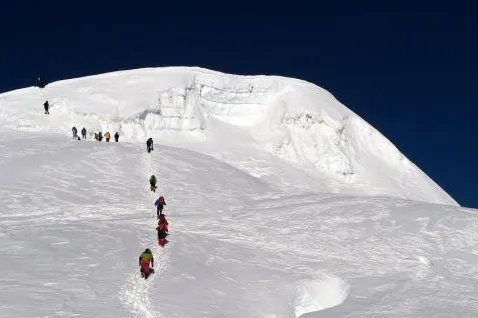
The Summit Push
Summit day begins between 1:00-3:00 AM depending on conditions and team pace. The early start ensures you're descending before afternoon weather deterioration.
Summit Day Sequence:
- Base Camp to Crampon Point (2-3 hours): Navigate moraine and glacier approach in darkness by headlamp
- Crampon Point to Headwall Base (1-2 hours): Roped glacier travel across the Imja Glacier, crevasse awareness critical
- Headwall Ascent (2-3 hours): 45-65 degree ice/snow slope with fixed ropes, using jumar ascenders
- Summit Ridge (1-2 hours): Exposed knife-edge ridge requiring careful movement, some rock scrambling
- Summit (6,189m): Brief celebration, photos, then immediate descent begins
- Descent to Base Camp (4-6 hours): Rappelling headwall, retracing glacier route
Summit Day Key Points:
- Total duration: 10-14 hours round trip
- Vertical gain from base camp: Approximately 1,000 meters
- Technical sections: Glacier crossing, headwall, summit ridge
- Weather window: Must summit by 10-11 AM ideally
- Turn-around time: Guides enforce strict time limits for safety
The headwall is the climb's crux — a sustained steep section requiring confidence on fixed ropes. Your Sherpa guide leads, fixing additional protection as needed and coaching technique throughout.
Difficulty Level & Physical Requirements
Island Peak climbing difficulty is rated Alpine PD+ (Peu Difficile, "slightly difficult"). In practical terms, this means the climb presents genuine challenges but remains accessible to prepared non-professional climbers.
Technical Difficulty Breakdown
The climb divides into distinct difficulty zones, each requiring different skills and fitness levels.
Non-Technical Sections (Lukla to Chhukung):
- Standard trekking terrain
- Well-marked trails
- Teahouse accommodation
- 5-7 hours walking daily
- Cumulative altitude gain builds fitness
Semi-Technical Section (Chhukung to Base Camp):
- Rough moraine terrain
- No maintained trail
- Route-finding required
- Camping environment begins
- Physical demands increase
Technical Section (Base Camp to Summit):
- Glacier travel with crevasse risk
- Fixed rope ascent (jumar technique)
- Crampon and ice axe use required
- Exposed ridge walking
- High altitude effects compound difficulty
Physical Fitness Requirements
Island Peak demands serious physical preparation. The combination of altitude, technical terrain, and a 10-14-hour summit day requires genuine cardiovascular and muscular endurance.
Minimum Fitness Benchmarks:
- Ability to trek 7-8 hours consecutively at altitude
- Comfortable hiking uphill for extended periods
- Core strength for the climbing harness load
- Upper body strength for jumar ascent
- Mental stamina for pre-dawn summit push
Recommended Pre-Trip Training (3-6 months):
- Regular cardio: Running, cycling, stair climbing (4-5x weekly)
- Hiking with a pack: Weekend hikes with 10-15 kg load
- Strength training: Legs, core, shoulders, and grip
- High-altitude simulation: If available, altitude training masks or chambers
- Practice climbs: Indoor climbing walls, outdoor scrambling
Honest Assessment:
If you can complete a challenging 8-hour mountain hike with significant elevation gain while carrying a pack, you have the baseline fitness for Island Peak. However, the altitude multiplies every effort — what feels moderate at sea level becomes genuinely hard above 5,000 meters.
Altitude, Acclimatization & Safety
| Altitude Zone |
Elevation |
Physiological Impact |
| Moderate |
2,500-3,500m |
Mild effects, adaptation begins |
| High |
3,500-5,500m |
Significant adaptation required |
| Very High |
5,500-6,500m |
Severe stress, limited acclimatization possible |
Our Acclimatization Protocol
This 12-day Island Peak climbing itinerary includes strategic acclimatization built into the schedule — not rushed add-ons, but essential rest days at key altitudes.
Day 3: Namche Bazaar (3,440m) First acclimatization day. Optional hike to Everest View Hotel (3,880m) then return to sleep at lower elevation. Classic "climb high, sleep low" approach.
Day 6: Dingboche (4,410m) Second acclimatization day. Critical adaptation before pushing higher. Optional hike toward Chhukung Ri for additional altitude exposure.
Acclimatization Best Practices:
- Hydrate aggressively: 4-5 liters daily
- Avoid alcohol entirely during acclimatization
- Eat regularly even without appetite
- Sleep is healing — prioritize rest
- Report symptoms immediately to guide
- Diamox (Acetazolamide) available if recommended by doctor
Altitude Sickness Recognition
Acute Mountain Sickness (AMS) affects most climbers to some degree. Recognizing symptoms early prevents progression to dangerous conditions.
Mild AMS Symptoms (Common, Manageable):
- Headache
- Loss of appetite
- Nausea
- Fatigue
- Disturbed sleep
- Dizziness
Severe Symptoms (Require Immediate Descent):
- Persistent severe headache unrelieved by medication
- Vomiting
- Ataxia (loss of coordination)
- Confusion or altered mental state
- Breathlessness at rest
- Persistent cough (possible HAPE)
Safety Protocols:
- Guides carry pulse oximeters for monitoring
- Emergency oxygen available at base camp
- Helicopter evacuation arranged within hours if needed
- Comprehensive travel insurance mandatory (minimum $100,000 coverage including helicopter rescue)
- Satellite communication for emergency contact
Island Peak Climbing Permits & Regulations
Legal climbing on Island Peak requires specific permits and compliance with Nepal government regulations. All permits are included in our package price and processed on your behalf.
Required Permits
| Permit Type |
Issuing Authority |
Approximate Cost |
| Island Peak Climbing Permit |
Nepal Mountaineering Association (NMA) |
$125-250 USD (seasonal) |
| Sagarmatha National Park Entry |
Department of National Parks |
$30 USD |
| Khumbu Pasang Lhamu Rural Municipality |
Local Government |
$20 USD |
Permit Cost Variations:
- Spring season (March-May): $250 USD
- Autumn season (September-November): $125 USD
- Winter season (December-February): $70 USD
Mandatory Requirements
Nepal's 2023 mountaineering regulations (reinforced 2024-2025) require:
Licensed Guide Requirement: All climbers must be accompanied by a licensed climbing guide registered with the Nepal Mountaineering Association. Solo or unguided climbing is prohibited.
Insurance Verification: Proof of travel insurance covering high-altitude rescue (helicopter evacuation to 6,500m+) is mandatory at permit registration.
Agency Registration: Climbing permits must be obtained through a registered Nepal trekking/mountaineering agency. Individual direct applications are not accepted.
Permit Validity:
- Permits are date-specific and non-transferable
- Valid only for the stated climbing season
- Must be carried during the climb for checkpoint verification
All these requirements are handled by Himalayan Hero as part of your Island Peak climbing package. You provide passport copies and insurance documentation; we manage the bureaucracy.
Also checkout our detailed guide on necessary travel insurance for trekking in Nepal.
Role of a Licensed Island Peak Climbing Guide
Your Island Peak climbing guide is far more than a route leader — they're your technical instructor, safety manager, and summit partner. Understanding their role helps you maximize the experience.
Guide Responsibilities
Technical Instruction:
- Fixed rope and jumar technique training
- Crampon walking instruction
- Ice axe self-arrest practice (if conditions allow)
- Rope team movement on glaciers
- Harness and equipment fitting
Safety Management:
- Continuous altitude sickness monitoring
- Weather assessment and go/no-go decisions
- Route finding and hazard identification
- Crevasse rescue capability
- Emergency response coordination
Logistics Coordination:
- Camp establishment and management
- Climbing Sherpa team supervision
- Communication with base camp and Kathmandu office
- Permit verification at checkpoints
- Client welfare throughout
Guide Qualifications
Himalayan Hero employs only guides meeting strict criteria:
Minimum Requirements:
- Nepal Mountaineering Association climbing guide license
- Minimum 5 years Island Peak guiding experience
- Wilderness First Responder certification (or equivalent)
- Fluent English communication
- Multiple successful Island Peak summits
Our Guide-to-Client Ratio:
- Maximum 2 clients per climbing Sherpa on summit day
- Additional support Sherpa for logistics and safety
- Lead guide oversight of entire team
This ratio ensures personalized attention during technical sections. Your guide can coach you through the headwall step-by-step rather than managing a large group.
Equipment & Technical Climbing Requirements
Island Peak climbing requires specialized mountaineering equipment beyond standard trekking gear. Understanding requirements helps you prepare appropriately.
Personal Climbing Equipment
Required Technical Gear:
- Mountaineering boots (B2 or B3 rated, crampon-compatible)
- Crampons (12-point, fitted to your boots)
- Ice axe (general mountaineering style, 55-65cm)
- Climbing harness
- Locking carabiners (minimum 3)
- Ascender/Jumar device
- Figure-8 or tube-style descender
- Prusik cord (for backup)
- Climbing helmet
- Headlamp with spare batteries
Personal Clothing:
- Expedition-weight down jacket (-20°C rated minimum)
- Hardshell jacket and pants (Gore-Tex or equivalent)
- Insulating mid-layers (fleece/softshell)
- Base layers (moisture-wicking)
- Insulated climbing gloves
- Liner gloves
- Warm hat/balaclava
- Glacier glasses (Category 4 UV protection)
- Gaiters
Sleeping & Personal:
- Sleeping bag (-25°C comfort rating)
- Sleeping mat (R-value 5+)
- Headlamp with spare batteries
- Water bottles (2L minimum, insulated)
- Personal medications
- Sunscreen (SPF 50+) and lip balm
Equipment Rental Options
Technical climbing gear can be rented in Kathmandu if you prefer not to purchase or transport your own:
Available for Rent:
- Mountaineering boots
- Crampons
- Ice axe
- Climbing harness
- Ascender
- Down jacket
- Sleeping bag
Rental Considerations:
- Quality varies significantly between shops
- Fit is critical for boots and crampons — test thoroughly
- Book popular items in advance during peak season
- Budget approximately $150-250 for full technical gear rental
We provide detailed equipment lists and Kathmandu rental recommendations upon booking.
Best Season for Island Peak Climbing
Timing significantly impacts Island Peak climbing success rates, safety, and overall experience. Two primary seasons offer optimal conditions.
Autumn Season (September-November)
Peak Months: October and November
Autumn delivers the most stable weather and clearest visibility of the year. Post-monsoon air clarity creates extraordinary mountain views throughout the approach trek.
Autumn Conditions:
- Clear skies predominate
- Moderate temperatures (cold but not extreme)
- Stable weather patterns
- Lower precipitation
- Best visibility of the year
- Higher trail traffic (busier teahouses)
Spring Season (March-May)
Peak Months: April and May
Spring offers warming temperatures and longer days. Late spring (May) provides the best summit conditions before monsoon arrival.
Spring Conditions:
- Gradually warming temperatures
- Longer daylight hours
- Rhododendron blooms on lower trails
- Increasing cloud cover toward May
- Snow conditions are often better than in autumn
- Pre-monsoon instability possible late May
Checkout our detailed guide on the best time for Nepal trekking, month by month guide.
Season Comparison
| Factor |
Autumn (Oct-Nov) |
Spring (Apr-May) |
| Weather Stability |
Excellent |
Good to Very Good |
| Visibility |
Best |
Very Good |
| Temperature |
Cold |
Moderate |
| Trail Traffic |
High |
Moderate-High |
| Permit Cost |
$125 |
$250 |
| Snow Conditions |
Variable |
Often better |
Seasons to Avoid
Monsoon (June-August): Heavy precipitation, trail leeches, cloud cover obscuring views, dangerous climbing conditions. Not recommended.
Winter (December-February): Extreme cold, potential heavy snowfall, shorter days, some teahouses closed. Possible for experienced climbers but significantly more challenging.
Why Choose Himalayan Hero for Island Peak Climbing
Selecting the right operator for your Island Peak climbing expedition directly impacts safety, success, and overall experience. Here's what distinguishes Himalayan Hero.
Our Approach
Safety-First Philosophy: We maintain conservative turn-around times, strict weather protocols, and never pressure clients to continue when conditions suggest otherwise. Summit success matters, but everyone returning safely matters more.
Experienced Local Team: Our climbing Sherpas average 8+ years of Island Peak guiding experience. They know this mountain intimately — every crevasse, weather pattern, and route variation.
Small Group Sizes: Maximum 8 clients per departure ensures personalized attention. On summit day, our 2:1 client-to-Sherpa ratio provides genuine support through technical sections.
Transparent Operations: No hidden fees, clear inclusions/exclusions, and honest communication about what the climb involves. We'd rather you choose a different operator than be unprepared for the reality.
What Sets Us Apart
Pre-Trip Support:
- Detailed equipment guidance
- Training recommendations
- Gear rental connections in Kathmandu
- Visa and insurance assistance
- Pre-departure briefing
On-Mountain Excellence:
- Experienced, certified guides
- Quality expedition equipment
- Nutritious high-altitude meals
- Emergency protocols and equipment
- Flexible response to conditions
Post-Climb Care:
- Summit certificates for successful climbers
- Photo sharing
- Feedback welcome for continuous improvement
- Future climb recommendations
Book Your Island Peak Climbing Expedition
Island Peak climbing offers the rare combination of genuine mountaineering achievement and accessible challenge. Standing on that 6,189-meter summit, surrounded by the giants of the Himalaya, you'll understand why this peak has launched thousands of climbing careers.
Our 12-day itinerary delivers this experience with professional support, comprehensive safety protocols, and the expertise of guides who know this mountain like home.