There's a moment that almost every first-time visitor to Nepal talks about. You're somewhere on a trail — tired, maybe a little lost — and a local passes by, presses their hands together, and says "Namaste" with a smile that somehow feels entirely genuine. You try to say it back, probably mispronouncing it, and they laugh warmly and keep walking.
That tiny exchange changes something. It makes you feel less like a tourist and more like a guest.
Nepal is one of the most welcoming countries in the world. But that warmth opens up much more when you meet locals even halfway. Knowing a few Nepali greetings before you arrive isn't about becoming fluent. It's about showing respect — and in Nepal, that matters enormously.
This guide covers everything a first-time traveler needs to know about greetings in Nepal. Whether you're heading to Everest Base Camp, exploring the Annapurna region, walking through Kathmandu, or trekking quiet trails in the Langtang Valley — these phrases will serve you well.
Understanding Nepali Culture and Why Greetings Matter So Much
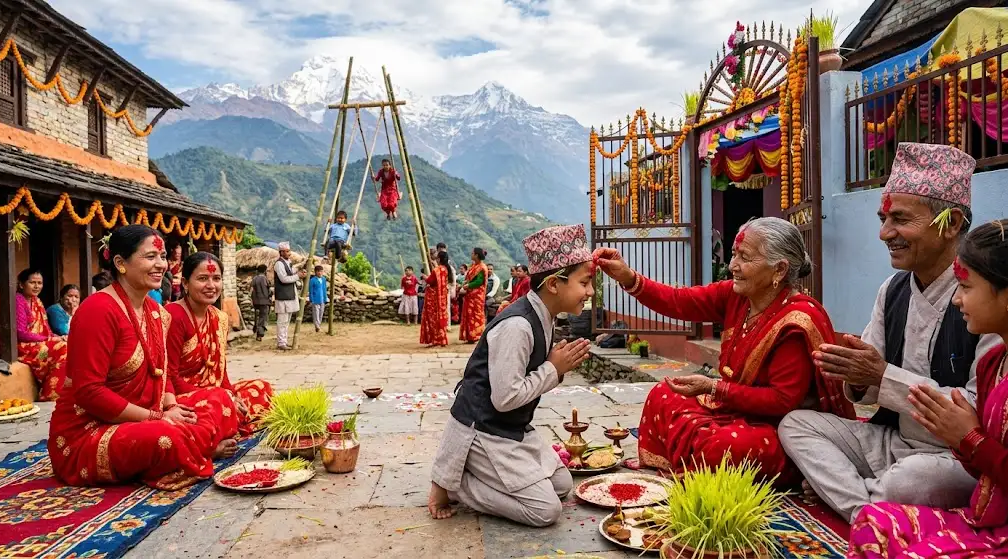
Nepal sits at the crossroads of Hindu and Buddhist traditions, and both place enormous value on respect, community, and acknowledgment. When you greet someone properly here, you're not just saying hello — you're communicating that you see them, that you honor them, that you aren't just passing through without noticing.
Nepali hospitality has a phrase behind it: atithi devo bhava, a Sanskrit expression meaning "the guest is equivalent to God." It's taken seriously. Locals — particularly in rural trekking areas and remote mountain villages — will go out of their way to help you, feed you, and make you feel at home. A simple, well-pronounced Namaste in return goes a long way.
One important thing to understand: Nepali culture is largely non-confrontational and deeply hierarchical. Elders are greeted first and with greater deference. Strangers are approached with warmth but also a certain respectful distance. Reading these social cues takes time, but getting the greeting right is the single most effective shortcut.
The Most Common Greetings in Nepal You Should Know
Namaste — The Word That Opens Every Door
Namaste (नमस्ते) is the most widely used greeting in Nepal, and it works in almost every situation — meeting someone for the first time, entering a shop, starting a conversation on the trail, or acknowledging a guide in the morning.
It's pronounced nah-mah-STAY. The stress falls on the final syllable, not the second. Most tourists get it close enough; the effort itself is what counts.
Literally translated, Namaste means "I bow to the divine in you." It's said with hands pressed together at chest height — the same gesture you've probably seen in yoga classes. In Nepal, it's deeply embedded in daily life, not ceremonial. You'll hear it dozens of times a day.
Namaskar (नमस्कार) is a slightly more formal version of the same greeting, often used when greeting elders or people in positions of authority. Same gesture, more reverence. If you're visiting a monastery, meeting an elderly village leader, or being introduced to a trekking agency owner, Namaskar shows a level of respect that locals genuinely appreciate.
Good Morning, Good Evening, and How Are You?
Nepali has simple equivalents for these everyday phrases:
- Good morning — Subha bihani (SOO-bha bee-HA-ni)
- Good evening — Subha sandhya (SOO-bha SAHN-dya)
- How are you? — Tapai lai kasto cha? (tah-PIE lie KAS-toh chha)
- I am fine — Malai thikai cha (mah-LIE thi-KAI chha)
You won't need these constantly, but using Subha bihani when your tea house host serves you breakfast in the morning will earn you a genuinely surprised and delighted response. Most tourists never try.
Thank You — Dhanyabad
Dhanyabad (धन्यवाद) — pronounced dhahn-ya-BAAD — is one of the most useful words in your Nepal vocabulary. Use it often: when someone carries your bag, shows you the trail, refills your water, or simply helps you find your way.
A softer, more casual version is Shukriya (shoo-KREE-ya), borrowed from Urdu and used widely in conversational settings.
Goodbye
Saying goodbye in Nepali isn't as straightforward as you might expect. A common farewell is:
- Pheri bhetaula (FAIR-ee bhe-TAU-la) — "Let's meet again"
- Jaanus (JAA-noos) — A polite "go well" or "goodbye"
- Namaste again — completely acceptable as a farewell too
Pheri bhetaula is particularly lovely because it expresses hope for a future meeting. Locals use it sincerely, and saying it back feels like a real connection rather than a generic goodbye.
Useful Nepali Phrases for Trekkers and Travelers
Once you've got greetings down, a few extra phrases make a huge practical difference on the trail and in tea houses.
Asking for directions:
- Everest Base Camp kata cha? — "Where is Everest Base Camp?"
- Kata jane? (KAH-tah JAH-ne) — "Where to go?"
- Bahira kata cha? — "Where is the toilet?"
Ordering food and drinks:
- Ek dal bhat dinus — "One dal bhat, please"
- Chiya dinus (CHEE-ya dee-NUS) — "Please give me tea"
- Paani dinus — "Please give me water"
- Dhanyabad — after receiving anything
Basic polite phrases:
- Maaf garnuhos (maaf GAR-nu-hos) — "Excuse me / I'm sorry"
- Kati pugcha? (KAH-tee PUG-cha) — "How much does it cost?"
- Bistari bistari (bis-TAH-ree bis-TAH-ree) — "Slowly slowly" — a phrase used often on altitude trekking routes as both practical advice and a cultural reminder not to rush
That last one — bistari bistari — is almost a philosophy in the mountains. Guides say it constantly on steep ascents. It's good trekking advice and good life advice, and locals love when tourists use it back.
Greetings on the Trekking Trail
Trekking in Nepal is a uniquely social experience. The trails through the Everest, Annapurna, Manaslu, and Langtang Valley regions pass through living villages, not just scenic wilderness. You'll walk through farmyards, past monasteries, through school yards, and alongside locals carrying enormous loads on their backs.
On the trail, Namaste is the default exchange — between trekkers, between locals, between strangers. It's simple trail etiquette. When you pass someone, you say it. When they pass you, they say it. No conversation required, but the acknowledgment matters.
Your guide and porters deserve particular attention here. Many trekkers treat their guide professionally but forget the cultural warmth that makes the relationship genuinely rewarding. Greeting your guide in the morning with Subha bihani, asking Tapai lai kasto cha? over breakfast, and saying Dhanyabad at the end of a long day makes you the kind of trekker that guides remember fondly and go the extra mile for.
In tea houses, the family running the lodge is usually the entire operation — cooking, cleaning, carrying supplies. A warm Namaste when you arrive and a genuine Dhanyabad when you leave is noticed and appreciated. On remote routes like the Manaslu Circuit, where tourist numbers are lower, this cultural warmth is even more impactful.
Cultural Etiquette When Greeting People in Nepal
Getting the words right is half of it. The other half is the body language.
The gesture matters. When saying Namaste or Namaskar, press your palms together at chest height and give a slight nod or bow. This is called the anjali mudra in Sanskrit and signals respect across both Hindu and Buddhist contexts. You don't need to bow deeply — a slight incline of the head is enough.
Greet elders first. In a group setting, always acknowledge the oldest person present first. This isn't just courtesy — it's a fundamental social expectation in Nepali culture. Skipping elders to speak to younger people can read as disrespectful even if completely unintentional.
Physical contact. Handshakes are increasingly common in urban Kathmandu, particularly in business or tourism contexts. But in traditional and rural settings, the hands-together Namaste is far more appropriate — especially between men and women. Avoid hugging or kissing on the cheek as greetings; these are not standard Nepali customs.
Eye contact. Direct but not intense eye contact is generally comfortable and expected. Prolonged staring — especially at women — is considered rude. When interacting with local women in villages, be particularly mindful of respectful body language.
Mistakes Tourists Often Make When Greeting in Nepal
Saying "Namaste" robotically without the gesture. The word and the gesture together communicate respect. One without the other feels incomplete. Even a small press of the palms changes how the greeting lands.
Mispronouncing and giving up. Most Nepali people find mispronunciation charming and funny in a good way. The mistake is giving up entirely — defaulting to English when a poorly pronounced Nepali attempt would have been warmer and more connecting.
Ignoring greetings from locals. On trekking trails, some tourists walk past locals without any acknowledgment — especially when they're tired or focused on the path. This is noticed, and it lands poorly. A small Namaste costs nothing but means a lot.
Assuming English works everywhere. In Kathmandu and on popular trekking routes, English is widely spoken. But in remote villages on the Manaslu Circuit, upper Langtang, or off-route sections of the Annapurna region, basic Nepali phrases are not a luxury — they're genuinely necessary to communicate.
Treating Namaste as a novelty. Some tourists say Namaste excitedly as a kind of performance. Locals appreciate the effort but can tell the difference between genuine respect and novelty tourism. Saying it calmly and naturally, the way you'd say hello at home, reads far more authentically.
Do You Need to Learn Nepali Before Visiting Nepal?
No — and don't let that stop you from going.
English is widely understood in Kathmandu, Pokhara, and along the major trekking routes. Your guide will almost certainly be fluent. Restaurant menus in tourist areas are usually in English. Signs at checkpoints and national park entry points are bilingual.
But here's the honest version of that answer: the further you go from the main tourist circuit, the more Nepali helps. In remote villages along the Manaslu Circuit or upper sections of the Langtang Valley, locals may have very limited English. Basic Nepali — even just greetings and a few practical phrases — makes a real difference in those moments.
More than practically, knowing even five or six Nepali phrases changes the nature of your interactions. Locals relax. Conversations open up. People who would have stayed politely reserved suddenly become warm and curious. Nepal rewards effort in this way more than almost anywhere else.
You don't need a course or a textbook. Download a simple Nepali phrasebook app before you leave, listen to a few pronunciation guides on YouTube, and focus on the ten to fifteen words in this article. That's enough to change your trip.
Quick Nepali Greeting Cheat Sheet
Keep this on your phone for easy reference on the trail:
- Namaste / Namaskar — Hello / respectful hello (hands pressed together)
- Subha bihani — Good morning
- Subha sandhya — Good evening
- Tapai lai kasto cha? — How are you?
- Malai thikai cha — I am fine
- Dhanyabad — Thank you
- Shukriya — Thank you (casual)
- Maaf garnuhos — Excuse me / Sorry
- Kati pugcha? — How much?
- Bistari bistari — Slowly slowly
- Pheri bhetaula — See you again / Goodbye
- Chiya dinus — Please give me tea
What Travelers Actually Experience When They Use These Phrases
The reaction you get when you say Dhanyabad instead of "thanks" is hard to describe precisely, but travelers mention it constantly. Something shifts. The person you're talking to looks at you differently — with a kind of pleased surprise that someone made the effort.
On longer treks like Everest Base Camp, trekkers who interact with their guides using Nepali phrases often describe the relationship as the highlight of the trip. Guides appreciate it because it signals that you're genuinely interested in Nepal, not just in the mountains. That interest is reciprocated with stories, cultural insight, and a kind of warmth you can't get from a guidebook.
In remote village tea houses, sometimes the family running the lodge doesn't speak much English. A simple Dhanyabad after a meal, or a warm Namaste from a child in the courtyard returned with a surprised smile — these are the moments that stay with travelers long after they've forgotten the exact trail stats or elevation gains.
Nepal's warmth is genuine. But it opens fully to people who meet it with genuine effort.
Frequently Asked Questions
Is Namaste enough as a greeting in Nepal?
Yes, in almost all situations. Namaste works as a hello, a goodbye, and an acknowledgment in passing. It's appropriate in cities, on trekking trails, in temples, and in tea houses. If you only learn one word before visiting Nepal, make it Namaste — but say it with the hands-together gesture and mean it.
Do people in Nepal speak English?
In Kathmandu, Pokhara, and along popular trekking routes, English is widely spoken. Trekking guides, hotel staff, and most restaurant workers in tourist areas will communicate comfortably in English. In remote mountain villages, English becomes less common, and basic Nepali phrases become genuinely useful.
What is the most respectful greeting in Nepal?
Namaskar, used with hands pressed together and a slight bow, is considered the most respectful formal greeting — particularly appropriate for elders, spiritual figures, or formal introductions. On the trail and in everyday encounters, Namaste carries the same warmth with slightly less formality.
How do you say thank you in Nepali?
Dhanyabad (धन्यवाद) is the standard way to say thank you in Nepali. A more casual alternative is Shukriya. Both are well understood and genuinely appreciated when used by foreign visitors.
Is it hard to communicate as a tourist in Nepal?
On the main tourist and trekking routes, not at all. English is widely spoken and the tourism infrastructure is well-developed. The challenge increases in remote areas, but even there, a combination of basic Nepali phrases, gestures, and patience goes a long way. Nepali people are generally patient and warm with travelers who are making an honest effort to communicate.
What body language should I use when greeting someone in Nepal? Press your palms together at chest height and give a slight nod — this is the Namaste gesture. Avoid initiating handshakes in traditional settings, particularly with local women. Don't point at people with a single finger (use an open hand instead), and remove footwear before entering homes or temples when you see shoes left at the entrance.
A Final Word Before You Go
You don't need to be a linguist. You don't need to memorize a phrase book. You just need to try.
The thing about Nepali greetings is that they're not really about the words. They're about the intention behind them — the simple act of saying "I see you, I respect you, I'm glad to be in your country." That intention travels even through mispronunciation, through awkward hand gestures, through nervous laughter.
Nepal is extraordinary in its landscape, its culture, and the mountains that frame the horizon everywhere you look. But most travelers who fall completely in love with Nepal will tell you it's the people who really got them. The guides who become friends. The tea house families who feed you like their own. The children on the trail who say Namaste and sprint away giggling.
Learn a few words before you arrive. Use them often, and use them genuinely. Nepal will give you far more in return than you ever expected.