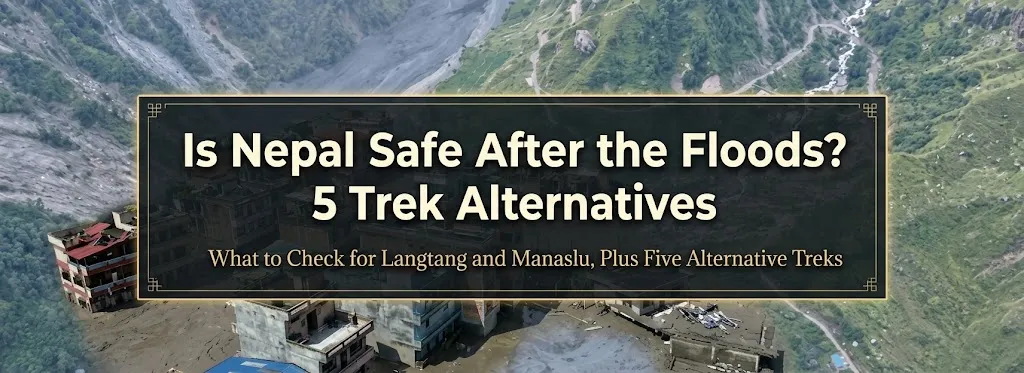
Two major floods have raised concerns about trekking in Nepal in autumn 2026. A flash flood reportedly affected the Bhote Koshi corridor near Syabrubesi on 26 August, while another damaged sections of the Budhi Gandaki valley on 11 October. Our thoughts are with the affected families, local communities, guides, and trekking workers.
Is Nepal safe to visit after the floods? Yes, many parts of Nepal may still be suitable for travel, but safety depends on current local conditions. Langtang access and the Manaslu Circuit need particular attention following the reported damage. In this blog, we explain the reported impacts, what travelers should check before departure, and five alternative treks: Upper Mustang, Everest Base Camp, the Annapurna Circuit, Mardi Himal, and Annapurna Base Camp. Always confirm trail access, road conditions, and accommodation with your trekking operator before travelling.
Is Nepal Safe to Visit After the 2026 Floods?
Nepal remains a destination for trekking and adventure travel, but safety depends on where you plan to go and the conditions on your travel dates.
The reports covered in this article identify two affected corridors:
- Langtang: Road access near Syabrubesi was reportedly damaged by the 26 August flood.
- Manaslu: Bridges and trail sections in the lower Budhi Gandaki valley were reportedly damaged on 11 October.
These reports do not mean every trekking region in Nepal is closed. They also do not prove that every other region is operating normally. Before booking or travelling, check the latest information with your trekking operator, local authorities, and relevant tourism organizations.
What does an open trekking route mean?
An open route should have usable access, passable trails, and accommodation operating along the planned itinerary. Even then, conditions can change. Floods and landslides can damage bridges, block roads, and make riverside trails dangerous. Heavy rain can also trigger new landslides after the main storm has passed.
Before departure, a responsible trekking operator should:
- Check road access, bridges, and trail conditions with local contacts.
- Confirm whether teahouses and other essential services are operating.
- Review weather forecasts and any local travel restrictions.
- Reassess the itinerary if a section is unsafe.
- Allow buffer days for road closures, flight delays and other disruptions.
For official tourism information, visit the Nepal Tourism Board and the Trekking Agencies' Association of Nepal (TAAN).
What Did the 2026 Floods Affect in Nepal?
The following table summarizes the reported situation described in this article. It is not an independently verified, live trail-status report. Confirm each route's current condition before publishing this information or making travel arrangements.
What happened near Syabrubesi and Langtang?
Syabrubesi is the main starting point for the Langtang Valley Trek. It also provides access to the Gosaikunda and Tamang Heritage Trail routes. The flash flood that affected the Bhote Koshi corridor near Syabrubesi on 26 August 2026 caused disruption in the area. Damage to access routes and infrastructure has affected trekking operations, and treks in the region have been suspended for several months.
If you are planning to visit Langtang, check with your trekking operator before making travel arrangements. Confirm whether trekking operations have resumed, which access routes are available, and whether local authorities have cleared the trails for visitors. You can check the Langtang Valley Trek package for itinerary details and updates before planning your trip.
What happened in the Manaslu region?
A flood affected the Budhi Gandaki valley on 11 October 2026, damaging bridges, trekking trails and riverside settlements. The damage disrupted access to parts of the Manaslu region, making it difficult to continue trekking safely. Even a damaged bridge or a blocked trail can affect the entire trekking route.
The Manaslu Circuit Trek has been suspended while the damage is assessed. If you are planning this trek, confirm the latest trail conditions and reopening status with local authorities and Himalayan Hero's field team before travelling. If you have already booked, contact your operator before heading to the trailhead. You can review the Manaslu Circuit Trek itinerary for trip details and updates.
What Do Government Travel Advisories Say About Nepal?
Government travel advisories are useful for understanding national security, health risks, transport disruption and other travel concerns. They should be read alongside local trekking updates.
Check the latest advice from your home country's government:
A national advisory may not mention every damaged bridge or closed trail. Ask your trekking operator for specific information about the route, transport, and accommodation included in your itinerary.
Is Nepal Safe for Tourists Day to Day?
Flood damage is one concern. Travellers should also prepare for the usual risks associated with visiting Nepal and trekking in the Himalayas.
Is petty crime a concern in Nepal?
Petty theft and tourist overcharging can occur in busy areas, including Thamel in Kathmandu. Keep your passport and valuables secure, use reliable transport, and agree on prices before buying services. For trekking, book through a reputable operator and confirm what your package includes.
How can you avoid altitude sickness?
Altitude sickness can affect anyone, regardless of age or fitness. It is an important risk on high-altitude treks such as Everest Base Camp and the Annapurna Circuit.
To reduce the risk:
- Ascend gradually and follow your acclimatization schedule.
- Know the warning signs, including headache, nausea, dizziness, and unusual tiredness.
- Tell your guide if symptoms develop.
- Do not continue ascending when you have symptoms of altitude sickness.
- Descend and seek medical help if symptoms worsen or serious warning signs appear.
A guide can help monitor your condition, but no guide or itinerary can eliminate the risk entirely.
Is Nepal safe for solo and female travelers?
Yes, Nepal is generally safe for solo and female travelers, but safety depends on the destination, current conditions, and travel plans. Share your itinerary with someone at home, keep emergency contacts handy and arrange reliable transport. For remote treks, consider hiring a licensed guide or joining an organized group, especially when floods or trail damage may affect access and safety.
Do you need travel insurance for trekking in Nepal?
Yes. Choose a policy that covers the maximum altitude of your trek and emergency helicopter evacuation where required. Check the policy wording for exclusions involving natural disasters, trail closures, trip cancellation, and travel disruption. Do not assume that every policy covers evacuation or every activity automatically.
What Are the 5 Best Alternatives to Langtang and Manaslu?
If your original trek is disrupted, you may be able to switch to another region. The best alternative depends on your available days, fitness, budget, and what you wanted from the original trek. The following durations are typical planning estimates, not verified statements of the current duration of every Himalayan Hero package. Check the linked itinerary before publishing final package-specific figures.
1. Upper Mustang Trek: A Cultural Alternative to Manaslu
Best for: Travellers who want remote villages, distinctive landscapes, and Tibetan-influenced culture.
Upper Mustang lies in the rain shadow of the Himalayas. Its landscape features dry valleys, eroded cliffs, cave settlements, and traditional villages. The walled city of Lo Manthang, at about 3,840 meters, is one of the region's main highlights. Unlike the Manaslu Circuit, Upper Mustang offers a different landscape and cultural experience. It is a good option for travellers who value remote settlements and local traditions as much as mountain scenery.
Why choose Upper Mustang?
- Explore landscapes that differ from Nepal's greener trekking valleys.
- Visit traditional villages and historic monasteries.
- Experience a remote Himalayan region with a distinct cultural identity.
- Trek at a lower maximum altitude than Everest Base Camp or Thorong La.
Difficulty: Moderate to challenging, depending on the itinerary. Long walking days, dry conditions, wind, and altitude can still make the trek demanding.
Permit requirements: Upper Mustang is a restricted area. Special permits and other applicable trekking requirements must be arranged before departure. Confirm current fees and rules with your operator.
What to check after the floods: Road access, weather, accommodation, and the current permit arrangements.
2. Everest Base Camp Trek: An Alternative for Bucket-List Travellers
Best for: Travellers who want to see Everest and experience the Khumbu region.
The Everest Base Camp Trek takes you through Sherpa settlements, suspension bridges, mountain valleys, and high-altitude landscapes. The route passes through well-known stops such as Namche Bazaar, Tengboche, Dingboche, and Gorak Shep.
The destination, Everest Base Camp, sits at about 5,364 meters. Many itineraries also include Kala Patthar, a popular viewpoint at approximately 5,545 meters.
The linked Himalayan Hero package is a 14-day trek. It is a separate trip from Mardi Himal and does not require combining two trekking regions into one itinerary.
Why choose Everest Base Camp?
- Experience the Khumbu region and its mountain scenery.
- Visit Sherpa villages and Buddhist monasteries.
- Trek to one of the world's most recognized mountaineering destinations.
- Follow an established itinerary with planned acclimatisation days.
Difficulty: Challenging. The altitude, cumulative walking hours, and cold conditions require preparation and gradual acclimatization.
What to check after the floods: Confirm Lukla flight operations, current trail conditions, lodge availability, and weather-related delays. An open trekking region can still experience flight cancellations.
3. Annapurna Circuit Trek: A High-Pass Alternative to Manaslu
Best for: Experienced trekkers looking for a long route and a challenging mountain pass.
The Annapurna Circuit crosses varied landscapes, from lower valleys and villages to high-altitude terrain around Thorong La Pass. At about 5,416 meters, Thorong La is a demanding part of the trek.
Like the Manaslu Circuit, the Annapurna Circuit offers a multi-day journey with changing scenery, cultural experiences, and a major high-pass crossing. However, the routes have different access points, landscapes, and logistical requirements.
Why choose the Annapurna Circuit?
- Experience a long-distance Himalayan trekking route.
- Cross a high mountain pass.
- Explore villages and changing landscapes.
- Choose from itineraries of different lengths, depending on road access and the route planned.
Difficulty: Challenging. The high pass, altitude, and weather can make this trek demanding.
Important safety check: Do not assume the entire Annapurna Circuit is unaffected. Reports of damage or disruption near Chame and other parts of the Manang district must be checked against current local information. Confirm road access, trail conditions, and the planned pass-crossing itinerary before booking.
4. Mardi Himal Trek: A Shorter Trek from Pokhara
Best for: Travellers with limited time who want mountain views and a shorter itinerary.
The Mardi Himal Trek follows forest trails and mountain ridges in the Annapurna region. As you gain altitude, views open towards Machhapuchhre, also known as Fishtail, and the Annapurna range. It is shorter than many classic circuit treks, making it an option for travellers who cannot fit a longer journey into their holiday.
Why choose Mardi Himal?
- Enjoy close views of the Annapurna mountains.
- Walk through forests and high ridges.
- Choose a shorter itinerary than the Manaslu or Annapurna Circuit.
- Start your journey from the Pokhara area.
Difficulty: Moderate to challenging. Steep sections and changing weather and altitude can make the upper trail more demanding than its short duration suggests.
What to check after the floods: Confirm road access to the trailhead, current trail conditions, accommodation availability, and weather near the higher camps.
5. Annapurna Base Camp Trek: An Alternative to Langtang Valley
Best for: Travellers who want a multi-day trek to a high mountain destination.
The Annapurna Base Camp Trek leads into a natural mountain sanctuary surrounded by peaks. At approximately 4,130 metres, Annapurna Base Camp offers a different experience from the Langtang Valley, but it can suit travellers seeking a similar combination of mountain scenery, villages, and several days of walking. The trail usually begins from the Pokhara region, with the precise starting point depending on road access and the itinerary.
Why choose Annapurna Base Camp?
- Reach a high-altitude destination surrounded by Himalayan peaks.
- Experience forests, villages, and changing mountain landscapes.
- Choose an itinerary that can fit a shorter holiday.
- Trek in the Annapurna region rather than using the Langtang gateway.
Difficulty: Moderate to challenging. Walking hours, steep stone steps, altitude, and weather all affect the difficulty.
What to check after the floods: Confirm the road to the trailhead, trail conditions, lodge operations, and local weather. Do not treat the region as automatically safe without a current assessment.
How Do You Choose the Right Trekking Alternative?
Start by deciding what you liked most about your original plan.
- Want culture and remote villages? Consider Upper Mustang.
- Want an iconic Himalayan journey? Choose Everest Base Camp if you have enough time and are prepared for the altitude.
- Want a long trek with a high pass? Consider the Annapurna Circuit, after confirming access.
- Have limited time? Look at Mardi Himal.
- Want a high mountain destination similar in style to Langtang? Consider Annapurna Base Camp.
Next, compare the walking days, total holiday length, fitness requirements, and budget. Remember that travel to the trailhead and return journeys also take time. Most importantly, choose a trek based on its current conditions rather than its reputation. Ask your operator to confirm the route, road access, accommodation, and any local restrictions before you make a final decision.
What If You Have Already Booked Langtang or Manaslu?
If you booked a Langtang or Manaslu trek with Himalayan Hero, contact the team before making new travel arrangements.
Depending on the current route status and your booking terms, possible options may include:
- Switching to another trek: Consider Upper Mustang, Everest Base Camp, the Annapurna Circuit, Mardi Himal, or Annapurna Base Camp.
- Changing your departure date: This may be possible if your schedule is flexible and the original route becomes operational.
- Discussing a refund or credit: Available options depend on the booking conditions and the circumstances of the disruption.
Do not assume that every booking qualifies for a free transfer or full refund. Ask the team to explain the applicable terms before confirming a change.
How Can You Trek Safely in Nepal After the Floods?
Use this checklist before departure.
- Confirm road, bridge, and trail conditions with your trekking operator.
- Check official notices and local weather forecasts.
- Buy travel insurance that covers your trek's maximum altitude and emergency evacuation.
- Allow buffer days for road closures and flight delays.
- Travel with a qualified guide when required and appropriate for your route.
- Follow local instructions around damaged bridges, rivers, and landslide areas.
- Carry essential medication, suitable clothing, and emergency contacts.
- Share your itinerary with someone at home.
- Keep copies of your insurance details and travel documents.
- Reassess your plan if conditions deteriorate.
If local authorities or your guide advise against travelling through a section, do not attempt to cross it simply to keep to your schedule.
Conclusion: Nepal Has Alternatives, but Check Conditions First
The 2026 flood reports described here highlight disruption in two important trekking areas: Langtang and Manaslu. They do not mean that every trekking region in Nepal is closed, but they do mean travelers should check conditions carefully before departure. If your original plans change, Upper Mustang, Everest Base Camp, the Annapurna Circuit, Mardi Himal, and Annapurna Base Camp are five alternatives worth considering. Each offers a different combination of scenery, culture, altitude, and walking days.
Before booking, ask your operator to verify the latest route conditions and match the itinerary to your fitness, budget, and available time. At Himalayan Hero Adventures, our aim is to help you make an informed decision, understand your options, and plan responsibly. Choosing an alternative route can also support the guides, porters, teahouses, and local communities that depend on trekking.
Frequently Asked Questions About Nepal's Safety After the Floods
Is Nepal Safe to Visit After the Floods?
Yes, many parts of Nepal remain suitable for visitors, but check local conditions before travelling. The 2026 floods reportedly affected access near Syabrubesi and the Budhi Gandaki valley.
Is Nepal Safe for Solo Travellers?
Yes, Nepal welcomes many solo travellers, but good planning is important. Check weather and trail conditions, share your itinerary, and consider a licensed guide for remote treks.
Is Nepal Safe for American Tourists?
Yes, American tourists can visit Nepal with proper planning and current travel advice. Check the latest US travel advisory, confirm route access and arrange travel insurance that covers trekking and emergency evacuation.
Is the Manaslu Circuit Trek Open?
The Manaslu Circuit is reported closed as of 12 October 2026, pending a damage assessment. Confirm its current status and reopening date with local authorities and your trekking operator.
Is the Langtang Valley Trek Open?
Access to the Langtang Valley Trek has reportedly been disrupted by flood damage near Syabrubesi. Check current road, bridge and trail conditions before planning your trek.
Is the Annapurna Region Affected by the Floods?
The reported floods affected the Bhote Koshi and Budhi Gandaki corridors, but individual Annapurna routes still need checking. Confirm trail access and road conditions with your operator before booking.
Can I Change My Booked Trek to Another Region?
Yes, you may be able to change your trek, depending on your booking terms and availability. Ask Himalayan Hero about alternatives such as Mardi Himal, Annapurna Base Camp, the Annapurna Circuit, Upper Mustang or Everest Base Camp.
Is the Everest Base Camp Trek Available This Autumn?
The Everest Base Camp Trek may be an alternative, but current availability must be confirmed. Check Lukla flights, weather, trail access and lodge availability before departure.
Which Trek Is Best if I Have Only One Week?
Mardi Himal is a good choice for a one-week trekking holiday. It typically takes 5 to 7 days, with extra time needed for travel to and from Pokhara.