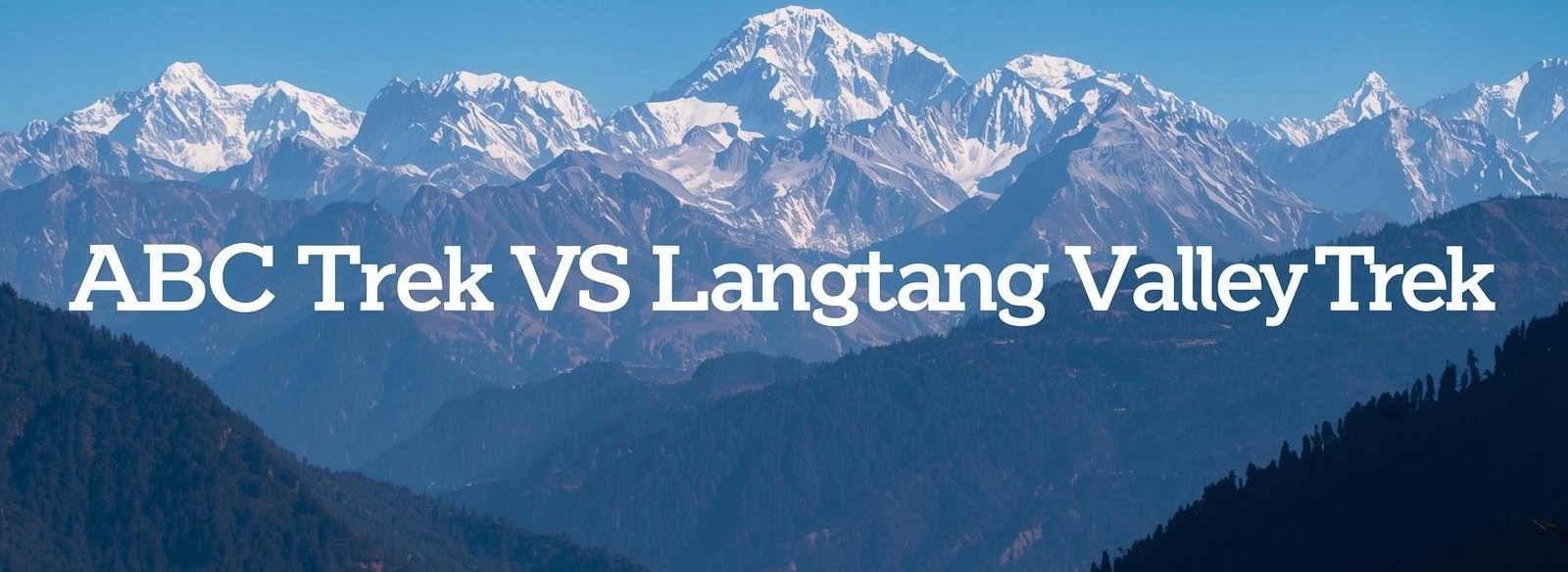
Two of Nepal's most rewarding moderate treks, one important decision. The Langtang Valley Trek vs Annapurna Base Camp Trek comparison comes up constantly among first-time Himalayan trekkers — and for good reason. Both are moderate difficulty, both offer world-class mountain scenery, and both can be completed without technical climbing skills. But they are meaningfully different experiences, and the right choice depends entirely on what you are actually looking for.
This guide gives you the honest, practical comparison you need to decide — covering difficulty, altitude, cost, scenery, culture, crowd levels, and which trek is better for specific types of trekkers.
Quick Answer: Langtang or Annapurna Base Camp?
If you are based in Kathmandu and want a shorter, less crowded, more culturally intimate trek, choose Langtang Valley. It starts closer to Kathmandu (no flight, just a 7–8 hour drive), takes 7–8 days, and sees a fraction of ABC's foot traffic.
If you want the most dramatic enclosed mountain sanctuary in Nepal — Annapurna's 360-degree bowl of 7,000 m and 8,000 m peaks — and don't mind a longer journey from Pokhara, choose Annapurna Base Camp. The scenery at ABC itself is arguably more dramatic, but it comes with more crowds, higher cost, and longer travel logistics.
Overview: What Each Trek Is
Langtang Valley Trek
The Langtang Valley Trek is Nepal's closest major Himalayan trekking route to Kathmandu. Starting from Syabrubesi in Rasuwa District, the trail follows the Langtang Khola river valley northward through dense rhododendron and oak forest, past small Tamang Buddhist settlements, into the wide glacial basin at Kyanjin Gompa (3,870 m). The route lies entirely within Langtang National Park — Nepal's first Himalayan national park — and reaches the Tibet border zone at its northern limit.
The defining character of Langtang is intimacy. The valley is narrow, the communities are small, and the mountain walls above Kyanjin Gompa rise almost vertically. It is not a panoramic viewpoint trek — it is an immersive valley experience that puts you inside the landscape rather than looking at it from a distance.
- 7–8 days total duration from Syabrubesi and back
- No domestic flight required — road access from Kathmandu
- Maximum standard altitude: 3,870 m at Kyanjin Gompa
- Optional high point: Tserko Ri (4,984 m) or Kyanjin Ri (4,773 m)
- Passes through Tamang Buddhist villages with active monastery culture
- Rated 5.5/10 difficulty — efficient and physically balanced
Annapurna Base Camp Trek
The Annapurna Base Camp Trek begins near Pokhara and climbs through the Modi Khola river valley into the heart of the Annapurna Sanctuary — a high-altitude glacial basin enclosed on all sides by peaks above 7,000 m. The route passes through Gurung and Magar villages including Ghandruk and Chhomrong before entering the sanctuary corridor above the bamboo zone.
The defining character of ABC is arrival. The moment you walk into the Annapurna Sanctuary and find yourself surrounded by a 360-degree wall of 7,000 m and 8,000 m peaks — Annapurna I (8,091 m), Annapurna South, Hiunchuli, Gangapurna, Machhapuchhre — is one of the most dramatic single moments in Nepal trekking.
- 10–12 days total duration from Nayapul (near Pokhara)
- Requires travel to Pokhara first (flight or 6–7 hour drive from Kathmandu)
- Maximum altitude: 4,130 m at Annapurna Base Camp
- Famous for Jhinu Danda natural hot springs on the descent
- Passes through well-developed Gurung and Magar village teahouse culture
- Rated 6/10 difficulty — slightly more demanding due to length and stone stair sections
Difficulty Comparison: Langtang vs ABC
Both treks are rated moderate — but they challenge you differently.
Langtang's hardest section is the single-day climb from Lama Hotel (2,380 m) to Langtang Village (3,430 m) — a 1,050 m elevation gain over 6–7 hours. The trail is direct and the altitude effects begin to register by the time you arrive. Outside of that day, the route is genuinely enjoyable walking through forest and open valley terrain.
ABC's most demanding section is the famous stone staircase to Ulleri — over 3,000 steps on Day 1 that test leg strength and resolve before you have even warmed up. The route is longer overall (115 km vs 65–70 km), involves more cumulative elevation change across 10–12 days, and the stone staircase sections between Chhomrong and the sanctuary entrance require sustained knee endurance on the descent.
- Langtang hardest day: Lama Hotel → Langtang Village (+1,050 m, 6–7 hrs)
- ABC hardest section: Ulleri stone staircase (3,000+ steps, Day 1) and Chhomrong descents
- Both treks have 5–7 hour daily walking averages
- Neither route requires technical climbing or special equipment
- Langtang is slightly shorter and involves less cumulative distance overall
For a detailed breakdown of what to expect physically on each day of the Langtang route, the Langtang Valley Trek difficulty guide gives a day-by-day analysis of the hardest sections and how to prepare for them.
Altitude and Acclimatization: Which Trek Is Higher?
Annapurna Base Camp (4,130 m) is 260 metres higher than Kyanjin Gompa (3,870 m) — a meaningful but not dramatic difference. Both treks sit in the moderate high-altitude zone where acclimatization matters but serious altitude sickness is less common than on Everest or Manaslu routes.
Langtang offers a built-in altitude advantage through its gradual ascent profile — the elevation gain from Syabrubesi (1,503 m) to Kyanjin Gompa (3,870 m) happens over four days of steady climbing, which most trekkers manage without significant difficulty. The optional Tserko Ri hike (4,984 m) is the highest point either trek offers and pushes into genuine high-altitude territory that requires a full acclimatization day at Kyanjin beforehand.
ABC's ascent is also gradual, but the final push from Machhapuchhre Base Camp (3,700 m) to ABC (4,130 m) gains altitude quickly and can cause headaches in trekkers who have not fully acclimatized. The standard itinerary manages this with a rest day at Chhomrong.
- Langtang max standard altitude: 3,870 m (Kyanjin Gompa)
- ABC max altitude: 4,130 m (Annapurna Base Camp)
- Langtang optional high point: 4,984 m (Tserko Ri)
- Both treks include acclimatization days in the standard itinerary
- Neither trek requires supplemental oxygen or altitude medication for most healthy trekkers
Mountain Views: Which Trek Has Better Scenery?
Honest answer: they offer fundamentally different visual experiences, and "better" depends on your personal preference.
Langtang delivers a corridor of peaks viewed from inside a narrow valley. You are surrounded by mountains — Langtang Lirung (7,234 m) towers directly above Kyanjin Gompa on the north face, and the glaciated ridgelines close in from both sides. The landscape is intimate and vertical.
ABC delivers the sanctuary experience — a wide, open basin at 4,130 m where you stand in the centre of a perfect 360-degree ring of 8,000 m peaks. Looking up at Annapurna I, the world's tenth-highest mountain, from directly below its south face is a different emotional experience from Langtang's enclosed drama.
- Langtang views: intimate vertical walls, glaciers at close range, Langtang Lirung dominant
- ABC views: wide 360-degree bowl of 8,000 m peaks; Annapurna I, Machhapuchhre, Hiunchuli
- Langtang viewpoints: Kyanjin Ri (4,773 m) and Tserko Ri (4,984 m) for panoramic elevation
- ABC viewpoint: the sanctuary floor itself at 4,130 m is the primary view destination
- Both treks offer rhododendron forest scenery at lower elevations in spring
Cultural Experience: Tamang vs Gurung Villages
The cultural character of each trek is genuinely distinct, and for culturally motivated trekkers this is a significant deciding factor.
Langtang passes through Tamang Buddhist communities — a Tibetan-origin culture whose architecture, religion, dress, and traditions reflect centuries of life on the Nepal-Tibet border. Kyanjin Gompa monastery at 3,870 m is an active spiritual centre, not a tourist attraction. The mani stone walls, prayer flags, and chortens that line the trail are living religious infrastructure, not decorative features. This is among the most culturally intact mountain communities accessible to trekkers in Nepal.
ABC passes through Gurung and Magar villages — particularly Ghandruk, Chhomrong, and Tadapani — where the culture reflects a different tradition, more influenced by the lower Himalayan foothills and with a longer history of trekking tourism. The villages are well-developed and hospitable, but the cultural experience is more familiar to international visitors because the trail has been heavily trafficked for decades.
- Langtang culture: Tamang Buddhist; Tibetan-influenced; Kyanjin Gompa monastery (3,870 m)
- ABC culture: Gurung and Magar; well-developed trail towns; famous hospitality
- Langtang offers more untouched cultural atmosphere with less tourist infrastructure pressure
- ABC villages are more comfortable and internationally oriented
- Both offer authentic teahouse culture with local food, guide interaction, and community life
For trekkers drawn to the Tamang cultural landscape specifically, the Tamang Heritage Trail Trek on Himalayan Hero extends the cultural immersion into the Tamang Himalaya region around Langtang — a route that prioritises villages, monasteries, and local life over altitude.
Trek Duration and Logistics: Which Is Easier to Reach?
Langtang is significantly faster and cheaper to access from Kathmandu.
Getting to the Langtang trailhead requires a single 7–8 hour road journey from Kathmandu to Syabrubesi — no flight, no additional city transit, no Pokhara hotel night. For travelers with limited time in Nepal, this is a material advantage.
Reaching the ABC trailhead requires traveling from Kathmandu to Pokhara first — either a 25-minute domestic flight (~USD 100–120) or a 6–7 hour road journey — and then onward to Nayapul. This adds a minimum of one full travel day and one additional logistical step to the pre-trek preparation.
- Kathmandu to Langtang trailhead: 7–8 hrs by road, no flight needed
- Kathmandu to ABC trailhead: Pokhara leg (flight or 6–7 hrs road) + Nayapul drive
- Langtang total trip from Kathmandu: 9–10 days including travel
- ABC total trip from Kathmandu: 13–15 days including Pokhara travel
- Langtang is the better choice for trekkers with 10 days or fewer in Nepal
Cost Comparison: Langtang vs ABC
Langtang is the more affordable option on almost every cost metric.
Permit costs are lower — approximately USD 38 for foreign nationals (USD 23 national park + USD 15 TIMS) vs approximately USD 60 for ABC (ACAP + TIMS). Transportation to the trailhead is cheaper — a single direct road journey from Kathmandu vs the Pokhara leg required for ABC. And the shorter 7–8 day duration means fewer nights of accommodation and meals.
Package costs reflect this: the Langtang Valley Trek 8-day package with Himalayan Hero starts from approximately USD 499, while equivalent ABC packages typically range from USD 600–900 depending on group size and duration.
- Langtang permit total: ~USD 38 (foreign nationals)
- ABC permit total: ~USD 60 (ACAP + TIMS)
- Langtang transport to trailhead: ~USD 15–30 (shared jeep or bus from Kathmandu)
- ABC transport: Pokhara flight (~USD 100–120 one-way) or 6–7 hr road + Nayapul drive
- Langtang overall cost advantage: approximately 20–35% cheaper than ABC end-to-end
Crowd Levels: Which Trek Is Less Busy?
Langtang is significantly less crowded than ABC — and this gap has widened in recent years as ABC's popularity has made its peak-season trails very busy.
The Annapurna region receives approximately 80,000+ trekking permit holders annually. The ABC route is one of the most-trafficked trails in Nepal, and during October–November and March–April, teahouses in Chhomrong and the sanctuary approach can feel genuinely busy. Booking accommodation in advance is strongly advisable.
Langtang sees a fraction of that traffic. The trail above Lama Hotel is noticeably quieter even in peak season, and Kyanjin Gompa retains an atmosphere of genuine mountain remoteness that the ABC approach corridor no longer offers.
- Langtang: low–moderate crowds; noticeably quiet above Lama Hotel even in peak season
- ABC: high crowds October–November and March–May; teahouse pre-booking advisable
- Langtang is the better choice for trekkers who prioritise solitude and trail space
- ABC trail buzz is part of its appeal for social trekkers who enjoy the international atmosphere
- Both treks have excellent teahouse infrastructure; ABC's is more developed at lower elevations
Best Season: Langtang vs ABC
Both treks share the same optimal seasonal windows — autumn and spring — with broadly similar weather patterns.
Autumn (October–November) is the gold standard for both treks: clearest skies, sharpest mountain views, dry trails, and stable conditions. The highest demand period for both routes.
Spring (March–May) delivers rhododendron blooms at lower elevations and excellent morning visibility. An increasingly popular alternative to autumn as peak-season trail congestion pushes trekkers toward quieter scheduling.
Winter (December–February) is possible on both treks but requires cold-weather preparation. Langtang above 3,000 m can see snow; ABC above 3,500 m is similar. Both trails are quieter in winter and offer sharp, cold views on clear days.
Monsoon (June–August) is not recommended for either trek. Persistent cloud cover obscures the peaks, trails become slippery, and leeches are active on the lower forest sections of both routes.
For a detailed month-by-month breakdown of Langtang conditions, the best time for the Langtang Valley Trek guide covers temperature ranges, precipitation, and seasonal trail conditions across the full year.
Which Trek Is Better for Beginners?
Both treks are beginner-friendly — but Langtang has a slight edge for true first-timers.
The shorter duration (7–8 days vs 10–12 days), lower maximum altitude, simpler logistics, and lower total cost all reduce the entry barrier for first-time Himalayan trekkers. The absence of a domestic flight removes one layer of logistical uncertainty. And the quieter trail means less social pressure and more space to find your own pace.
ABC is equally achievable for beginners with proper fitness preparation, but the longer duration, higher altitude, and Ulleri stone staircase on Day 1 make the learning curve slightly steeper. The reward at ABC — the sanctuary view — is dramatic enough that many beginners rate it the highlight of their Nepal trip despite the additional challenge.
- First-time Himalayan trekker with limited time: Langtang
- First-time trekker who wants the most dramatic single moment: ABC
- Both require 4–6 weeks of cardiovascular preparation beforehand
- Both are achievable without prior high-altitude experience
- Guide recommended for both; mandatory for Langtang (park regulations)
Pros and Cons: Langtang vs Annapurna Base Camp
Langtang Valley Trek
Pros:
- Closest major Himalayan trek to Kathmandu — no domestic flight
- Significantly less crowded than ABC
- Lower total cost (permits, transport, package price)
- Shorter duration fits tight schedules
- Living Tamang Buddhist culture; active Kyanjin Gompa monastery
- Optional Tserko Ri summit (4,984 m) for ambitious trekkers
- Red panda habitat in lower forest zone
Cons:
- Less dramatic mountain panorama than ABC's 360-degree sanctuary bowl
- No hot springs on the standard route
- Less developed trail infrastructure at higher elevations
- Fewer accommodation options above Langtang Village
Annapurna Base Camp Trek
Pros:
- Iconic 360-degree sanctuary of 7,000 m and 8,000 m peaks
- Jhinu Danda hot springs — a genuine physical reward on the descent
- More developed trail and teahouse infrastructure throughout
- Well-established Gurung and Magar cultural villages
- Classic Nepal trekking atmosphere with international trekker community
Cons:
- Requires travel to Pokhara first — adds time and cost
- Significantly more crowded during peak season
- Higher total cost (permits, Pokhara transport, longer duration)
- More logistically complex to organise independently
- Ulleri stone staircase is a brutal Day 1 introduction
Final Verdict: Which Trek Should You Choose in 2026?
Choose Langtang if: you are based in Kathmandu, have 8–10 days total, want a quieter trail, are drawn to Tibetan-influenced Buddhist culture, or want to spend less without sacrificing genuine high-altitude Himalayan scenery.
Choose Annapurna Base Camp if: you want the most theatrically dramatic base camp experience Nepal offers, have 13–15 days including Pokhara travel, enjoy the social energy of a busy international trekking trail, or specifically want the hot springs and the sanctuary bowl sunrise.
Neither trek is objectively better. They are different experiences designed for different priorities. The comparison table at the top of this article is the fastest way to identify which profile matches yours — but the honest truth is that both are worth doing, and many Nepal trekkers complete both on separate trips.
For complete itineraries, pricing, and booking details, visit the Langtang Valley Trek package and Annapurna Base Camp Trek package pages on Himalayan Hero.
Frequently Asked Questions
Is the Langtang Trek easier than Annapurna Base Camp?
Marginally yes. Both are moderate difficulty, but Langtang is slightly shorter (7–8 days vs 10–12), has a lower maximum altitude (3,870 m vs 4,130 m), and the hardest section is a single-day climb rather than ABC's multi-day stone staircase approach. Both are achievable for fit beginners with proper preparation.
Which trek has better mountain views — Langtang or ABC?
They deliver different visual experiences. ABC offers the more dramatic single moment — a 360-degree bowl of 8,000 m peaks at the sanctuary. Langtang offers an intimate enclosed valley with massive walls rising directly overhead. ABC is more panoramic; Langtang is more immersive.
Which trek is closer to Kathmandu?
Langtang, definitively. The trailhead at Syabrubesi is 117 km from Kathmandu by road — a single 7–8 hour drive with no domestic flight needed. ABC requires traveling to Pokhara first, adding one full day and one additional transport leg to the journey.
Is Langtang less crowded than Annapurna Base Camp?
Yes, significantly. The Annapurna region receives the highest trekking permit volume in Nepal. Langtang sees a fraction of that traffic year-round. For trekkers prioritising trail solitude and space, Langtang is the clear choice.
Which trek is cheaper — Langtang or ABC?
Langtang is cheaper on every metric: lower permit costs (~USD 38 vs ~USD 60), lower transport costs (single road journey vs Pokhara flight), and shorter duration means fewer nights and meals. Package prices start from USD 499 for Langtang vs USD 600–900 for ABC.
Which trek is better for beginners in Nepal?
Both are suitable for fit beginners. Langtang has a slight edge due to shorter duration, simpler logistics, and lower maximum altitude. ABC's Ulleri staircase is a steeper physical test on Day 1 but the reward at the sanctuary is among Nepal's most memorable trekking moments.
Can I do either trek without a guide?
A licensed guide is required for the Langtang Valley Trek under current Langtang National Park regulations. ABC does not have a mandatory guide requirement, though hiring one is strongly recommended for safety, navigation, and cultural understanding on both routes.
Which trek has a better cultural experience?
They offer different cultural experiences. Langtang's Tamang Buddhist culture — with its Tibetan language, Kyanjin Gompa monastery, and relatively unmodified village life — is considered more culturally distinctive and less commercialised. ABC's Gurung and Magar villages are well-developed, warm, and hospitable, but more familiar to international trekking visitors.