The Khumbu Icefall is a constantly moving section of the Khumbu Glacier on the southern route of Mount Everest, located between Everest Base Camp and Camp 1 at roughly 5,486 to 6,000 meters above sea level. It is a maze of deep crevasses, towering seracs, ice blocks, and unstable glacier terrain.
The Icefall is considered one of the most dangerous sections of the Everest climbing route because the glacier is always moving and changing. Large blocks of ice can collapse without warning, while crevasses can open or shift beneath climbers. Sherpa specialists known as Icefall Doctors create and maintain a route through this dangerous terrain using ladders, ropes, and fixed lines. This guide explains what the Khumbu Icefall is, why it is so dangerous, how climbers cross it, and what is known about deaths and bodies in the area.
What Is the Khumbu Icefall?
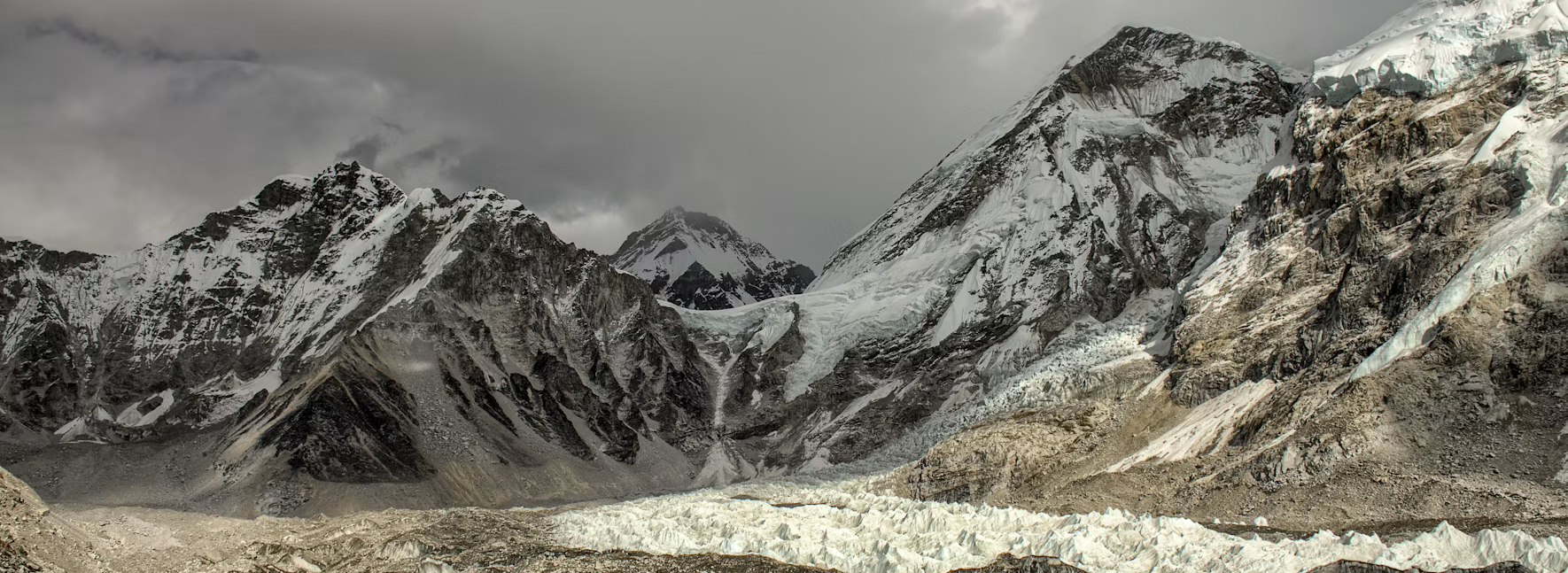
The Khumbu Icefall is a steep, constantly moving section of the Khumbu Glacier on Mount Everest's southern climbing route. It lies between Everest Base Camp and Camp 1 and is filled with deep crevasses, towering seracs, ice towers, and broken sections of glacier. Climbers must cross this unstable terrain before reaching the higher camps on Everest.
The term "icefall" describes a part of a glacier where the ice flows over steep or uneven ground and breaks apart into large blocks and cracks. In the Khumbu Icefall, the glacier moves continuously, causing crevasses to open, close, or change position and seracs to become unstable. This means the route is never completely fixed and must be regularly inspected and maintained.
| Feature |
Details |
| Elevation |
Approximately 5,486 to 6,000 meters |
| Location |
Between Everest Base Camp and Camp 1 |
| Glacier |
Khumbu Glacier |
| Everest route |
South Col route from Nepal |
| Main hazards |
Crevasses, seracs, falling ice, unstable glacier terrain |
The Khumbu Icefall begins above Everest Base Camp and rises toward the Western Cwm. Although it is not the highest section of an Everest expedition, its unstable nature makes it one of the most serious obstacles on the route. Climbers generally cross it using fixed ropes, ladders, and a route prepared and maintained by the Icefall Doctors.
Where the Khumbu Icefall Sits on the Everest Route
The Khumbu Icefall is located between Everest Base Camp, at about 5,364 meters, and Camp 1, at approximately 6,065 meters. Climbers leave Base Camp and enter the Icefall before continuing toward the relatively flatter Western Cwm and the higher camps on Everest.
Why Every South Col Climber Must Pass Through It
Climbers attempting Everest from the Nepal side must negotiate the Khumbu Icefall to reach the Western Cwm and continue toward Camp 2 and the higher sections of the mountain. There is no simple alternative route around this major glacier section on the standard South Col climbing route.
The route through the Icefall is not a permanent trail. Specialist Sherpa teams known as the Icefall Doctors establish and maintain a passage using fixed ropes, aluminum ladders, and other equipment. Because the glacier continues moving, the route can change during the climbing season.
The Khumbu Region and Sagarmatha National Park
The Icefall is part of theKhumbu region of Nepal and lies within Sagarmatha National Park. The region includes Everest Base Camp, Sherpa communities, glaciers, valleys, and some of the world's highest mountains.
Everest can also be approached from the north through Tibet, but the two sides have very different climbing routes. The Khumbu Icefall is specifically associated with the Nepal-side South Col route. Climbers approaching Everest from Tibet do not cross the Khumbu Icefall.
Why Is the Khumbu Icefall So Dangerous?
The Khumbu Icefall is dangerous because it is a moving glacier filled with unstable seracs, deep crevasses, falling ice, and avalanche exposure. Unlike a fixed mountain trail, its terrain changes continuously, meaning a route that is safe enough to cross one day can become more hazardous later in the expedition.
Constant Glacial Movement
The Khumbu Glacier is constantly moving downhill, and parts of the Icefall can shift significantly over short periods. Movement can alter the position and size of crevasses, tilt ice towers, and change the safest passage through the glacier.
This is one reason the route must be inspected regularly rather than treated as a permanent trail. The Icefall Doctors monitor conditions and adjust the climbing route when necessary.
Collapsing Seracs
Seracs are large blocks or towers of glacial ice created when a glacier fractures. Some seracs in the Khumbu Icefall are enormous and can remain apparently stable before suddenly breaking apart.
A collapsing serac can release huge amounts of ice and create a powerful impact or avalanche. Climbers cannot reliably predict exactly when an unstable ice formation will collapse, making falling ice one of the Icefall's most serious objective hazards.
Hidden Crevasses
Crevasses are deep cracks formed as moving glacier ice stretches and breaks. Some are narrow and visible, while others can be hidden beneath snow bridges.
A snow-covered crevasse can be particularly dangerous because a climber may not recognize the opening until the surface gives way. Some crevasses in glacial environments can extend many meters below the surface, making falls potentially catastrophic.
Avalanche Exposure
The Icefall also contains areas exposed to falling snow and ice from surrounding slopes and cliffs. Overhanging sections of ice can break away and send debris down through the route.
This exposure means climbers must consider not only the ground directly beneath their feet but also the unstable terrain above them.
Ladder Crossings
Fixed aluminum ladders are commonly used to cross large crevasses that cannot be safely negotiated on foot. Depending on the gap, climbers may cross one or more ladders secured across the crevasse.
Walking across a narrow ladder at high altitude requires balance and concentration, particularly while wearing crampons and carrying climbing equipment. The ladders can also move or flex slightly, adding to the challenge.
Why It's Crossed More Than Once
The Khumbu Icefall is not normally crossed only once during an Everest expedition. Climbers may pass through it multiple times while moving between Base Camp and the higher camps during acclimatization rotations and the summit push.
Sherpa guides and high-altitude workers may also make repeated journeys through the Icefall while transporting equipment and supplies. This repeated exposure matters because even when each individual crossing is completed safely, every additional passage creates another opportunity to encounter falling ice, changing crevasses, or unstable terrain.
How Deep Is the Khumbu Icefall?
The Khumbu Icefall does not have one fixed depth because it is a moving glacier rather than a single hole or canyon. Some crevasses are several meters deep, while the largest can extend 30 meters or more below the surface. The Icefall also rises roughly 600 meters vertically from its lower section near Everest Base Camp toward the Western Cwm.
Why "Depth" Is a Moving Target
When people ask how deep the Khumbu Icefall is, they are usually referring to the depth of its crevasses rather than the overall height of the Icefall. Crevasses form as the Khumbu Glacier moves over steep and uneven ground, and their size can change throughout the climbing season.
Some cracks are relatively narrow and shallow, while others are deep enough that climbers cannot see the bottom. Snow can also cover parts of a crevasse, creating a snow bridge that makes the opening difficult to identify from the surface.
The same applies to seracs. These large blocks and towers of ice can vary greatly in height, and their appearance changes as the glacier moves and fractures. For this reason, measurements reported for the Khumbu Icefall should be treated as approximate rather than permanent.
Icefall Stats at a Glance
| Feature |
Approximate figure |
| Vertical rise through the Icefall |
About 600 m |
| Elevation range |
About 5,486 to 6,000 m |
| Crevasse depth |
Some exceed 30 m |
| Crevasse size |
Highly variable and constantly changing |
| Serac height |
Varies from smaller blocks to very large ice towers |
| Glacier |
Khumbu Glacier |
The exact depth of an individual crevasse can only be determined through direct assessment, and conditions can change after measurement. This constant movement is one of the reasons the Khumbu Icefall remains such a serious objective hazard on the Everest South Col route. Also Read : Everest Map & Elevation.
A History of Danger: Khumbu Icefall Deaths
Deaths in the Khumbu Icefall have occurred throughout Everest's climbing history, but there is no single universally accepted death toll for the Icefall alone. Records can differ depending on whether they include only climbers or also Sherpa guides, porters, and other high-altitude workers. The 2014 disaster remains the deadliest single incident in the Icefall, with 16 Nepali climbing workers killed.
The 2014 Avalanche
On April 18, 2014, a large serac collapse triggered an avalanche in the Khumbu Icefall and struck Sherpa and Nepali high-altitude workers preparing the climbing route.
Key facts:
- Date: April 18, 2014
- Deaths: 16 Nepali climbing workers
- Cause: Falling ice and avalanche in the Khumbu Icefall
- Victims: Mainly Sherpa and other Nepali high-altitude workers
- Impact: Became a major turning point in discussions about Everest climbing safety and Sherpa working conditions.
The disaster showed that even experienced workers can face severe risks when repeatedly traveling through unstable glacier terrain.
Why Sherpa Climbing Staff Face Disproportionate Risk
Sherpa climbing staff can face greater cumulative exposure because they often cross the Icefall many more times than expedition clients.
- Carrying equipment, oxygen, food, tents, and ropes
- Establishing and maintaining fixed routes
- Making repeated trips between Base Camp and higher camps
- Supporting acclimatization rotations
- Repairing ladders and fixed ropes when conditions change
More crossings mean more exposure to hazards such as falling seracs, changing crevasses, and unstable ice.
On "Khumbu Icefall Bodies" and Everest Bodies Maps
Searches for "Khumbu Icefall bodies" and "Everest bodies map" are often related to the wider question of what happens to people who die on Everest.
- Body recovery in the Icefall can be extremely dangerous.
- Crevasses and unstable ice can make access difficult or impossible.
- Recovery teams may face the same hazards that caused the original accident.
- Some bodies therefore remain on the mountain.
- Locations can change or become inaccessible as the glacier moves.
- Online body maps should not always be treated as complete or permanently accurate.
These are human tragedies and should be discussed respectfully rather than presented as attractions or statistics.
Part of a Larger Everest Safety Conversation
The Khumbu Icefall remains one of the strongest examples of the objective risks involved in climbing Everest. Modern expeditions reduce these risks through:
- Weather forecasting
- Route monitoring
- Fixed ropes and ladders
- Experienced Sherpa teams
- Acclimatization rotations
- Careful timing of Icefall crossings
However, no system can completely eliminate the danger of a moving glacier.
The Icefall Doctors: Who Makes It Passable Each Year
The Icefall Doctors are a specialized team of Nepali high-altitude workers who prepare and maintain the climbing route through the Khumbu Icefall each Everest climbing season. Working under the Sagarmatha Pollution Control Committee (SPCC), they install ladders and fixed ropes, mark safe passages, and regularly adjust the route as the glacier moves.
Their work is essential because the Khumbu Icefall is not a fixed trail. The glacier continues to shift throughout the season, causing crevasses to open, ladders to become misaligned, and sections of the route to become unsafe.
The Icefall Doctors typically handle tasks such as:
- Installing aluminum ladders across large crevasses
- Fixing and maintaining ropes used by climbers
- Finding safer routes as the glacier changes
- Checking ladders and anchors for damage
- Removing or avoiding unstable sections of the Icefall
- Re-routing sections when new cracks or falling ice affect the established passage
Their work begins before most expedition teams make their major climbing rotations. They must assess a difficult and constantly changing glacier environment before creating a route that can be used by climbers and support staff.
A Differentiation Opportunity
The story of the Khumbu Icefall is not only about dangerous ice, Everest records, or climbing statistics. It is also about the Nepali workers who make the route possible.
The Icefall Doctors combine knowledge of glacier conditions, mountaineering skills, physical endurance, and practical experience in one of the world's most unstable climbing environments. Their contribution is especially important because they repeatedly work in an area where seracs can collapse and crevasses can change without warning.
For travelers and readers interested in Everest, understanding their role provides a more complete picture of what an Everest expedition involves. The mountain may attract international climbers, but much of the infrastructure that allows expeditions to operate safely is prepared and maintained by experienced Nepali mountain workers.
What It's Like to Cross the Khumbu Icefall
Crossing the Khumbu Icefall is unlike walking on a normal mountain trail. Climbers move carefully through a maze of ladders, fixed ropes, ice towers, and crevasses while wearing crampons and carrying climbing equipment. The route changes from season to season, so climbers follow the passage established and maintained by the Icefall Doctors.
Pre-Dawn Starts
Most Icefall crossings begin very early, often before sunrise. The main reason is temperature. During the colder hours, the snow and ice can be firmer and there may be less movement in some parts of the glacier.
A typical crossing involves:
- Starting before daylight with a headlamp
- Following fixed ropes through the marked route
- Crossing aluminum ladders over crevasses
- Moving carefully around large seracs and ice blocks
- Maintaining distance from other climbers
- Reaching safer terrain higher on the route as conditions warm
Starting early does not make the Icefall safe. Seracs can collapse and crevasses can shift at any time, but early travel can help reduce some of the risks associated with warming conditions.
Ladders, Headlamps, and the Sound of the Glacier
In darkness, a headlamp illuminates only a small section of the route ahead. The narrow beam can reveal ropes disappearing into the darkness, ladder crossings over deep crevasses, and walls of blue and white ice.
Crossing a ladder requires concentration. Climbers typically secure themselves to a fixed rope while stepping carefully across the rungs with crampons. The ladder may move slightly underfoot, particularly when crossing a wider crevasse.
The glacier itself is never completely silent. Ice can crack, shift, or settle as the Khumbu Glacier moves. These sounds are a reminder that the terrain beneath and around the climber is constantly changing.
Can You See the Khumbu Icefall on the Everest Base Camp Trek?
Yes, Everest Base Camp trekkers can see the Khumbu Icefall, but they do not cross it. The Icefall begins above Everest Base Camp and forms a dramatic wall of broken ice, crevasses, and seracs leading toward Camp 1. Trekkers can view this landscape from the Base Camp area and surrounding viewpoints without entering the dangerous climbing route.
What Trekkers Actually See
The distinction between trekking to Everest Base Camp and climbing Mount Everest is important. An EBC trek follows established trails through the Khumbu Valley and finishes at Everest Base Camp, while Everest climbers continue through the Khumbu Icefall toward Camp 1 and the higher camps.
At Base Camp, trekkers can see:
- The lower section of the Khumbu Icefall
- Large ice formations and seracs
- The glacier flowing toward Everest Base Camp
- Expedition tents during the climbing season
- Climbers and Sherpa teams preparing for higher sections
- The dramatic landscape surrounding the Everest route
Trekkers should not attempt to enter the Icefall. The route is specifically prepared for mountaineering expeditions and involves technical equipment, fixed ropes, ladders, and serious objective hazards.
Planning Your Own Trek
If your interest in the Khumbu Icefall comes from wanting to experience Everest rather than climb the mountain, the Everest Base Camp Trek offers a much safer way to get close to this remarkable part of the Everest landscape.
You can trek through the Sherpa villages, visit Namche Bazaar, experience the high-altitude environment, and reach Everest Base Camp without climbing the Icefall itself. For a guided experience with local support, you can explore Himalayan Hero's.
Frequently Asked Questions About the Khumbu Icefall
What is the Khumbu Icefall?
The Khumbu Icefall is a constantly moving section of glacier on Mount Everest. It forms where the Khumbu Glacier flows over steep, broken terrain between Everest Base Camp and the Western Cwm.
Where is the Khumbu Icefall located?
The Khumbu Icefall is located on the southern side of Mount Everest in Nepal. It lies between Everest Base Camp and the Western Cwm and is the first major technical obstacle on the standard South Col route.
Why is the Khumbu Icefall so dangerous?
The Khumbu Icefall is dangerous because the glacier is constantly moving and contains deep crevasses, towering seracs, unstable ice blocks, and steep sections. Ice can collapse without warning, making the route one of the most hazardous parts of an Everest expedition.
How high is the Khumbu Icefall?
The Khumbu Icefall begins at roughly 5,300 meters (17,400 feet) near Everest Base Camp and rises toward the Western Cwm at around 6,000 meters (19,700 feet). Its exact elevation varies across the icefall.
How long is the Khumbu Icefall?
The Khumbu Icefall is roughly 1.5 kilometers (about 1 mile) long, although its route and dimensions can change as the glacier moves.
How deep are the crevasses in the Khumbu Icefall?
Crevasses in the Khumbu Icefall vary greatly in size and depth. Some are relatively narrow, while others can be extremely deep. Climbers use ladders, fixed ropes, and other safety equipment to cross many of these openings.
How was the Khumbu Icefall formed?
The Khumbu Icefall formed as the Khumbu Glacier flows down from the Western Cwm over a steep drop in the glacier's terrain. The ice stretches, cracks, and breaks as it moves, creating crevasses, seracs, and other unstable formations.
How fast does the Khumbu Icefall move?
The Khumbu Glacier is constantly moving, and sections of the icefall can shift several feet each day. Movement varies by location and conditions, which is why the climbing route must be regularly inspected and adjusted.
Can you avoid the Khumbu Icefall?
There is no simple way to avoid the Khumbu Icefall when climbing Mount Everest by the standard Nepal-side route. Climbers must cross it to reach the Western Cwm, although route planners continually look for the safest available passage through the changing ice.
How long does it take to cross the Khumbu Icefall?
The time needed to cross the Khumbu Icefall varies with the route, conditions, traffic, and climber's experience. An experienced expedition team may spend several hours crossing it, with climbers usually starting very early when the ice is generally more stable.
How many climbers have died in the Khumbu Icefall?
The Khumbu Icefall has been the site of numerous climbing deaths, but there is no single fixed death toll because historical records and definitions vary. Fatalities have resulted from falling ice, collapsing seracs, crevasse falls, and other hazards.
Does the Khumbu Icefall melt?
The Khumbu Icefall is affected by seasonal warming and glacier melt, but it does not simply melt away. The glacier is constantly moving, fracturing, and being replenished by ice flowing down from higher elevations.
Why is the Khumbu Icefall called an icefall?
It is called an icefall because the glacier flows over steep terrain in a way that resembles a frozen waterfall. The moving ice breaks into large blocks, creating the distinctive landscape of the Khumbu Icefall.
What is the Khumbu Icefall known for?
The Khumbu Icefall is known as one of the most dangerous sections of the standard Everest climbing route. Its constantly shifting ice, deep crevasses, towering seracs, and unpredictable collapses make crossing it a major challenge for climbers.
Is the Khumbu Icefall the hardest part of climbing Everest?
The Khumbu Icefall is one of the most dangerous sections of the South Col route, but it is not necessarily the most technically difficult part of the entire climb. Other sections, such as the Lhotse Face and Hillary Step area, have also presented major technical challenges.
What happens if the Khumbu Icefall collapses?
A collapse can send large blocks of ice and snow downhill and may destroy parts of the established climbing route. Because the terrain can change rapidly, expedition teams monitor the icefall and adjust the route when conditions become unsafe.