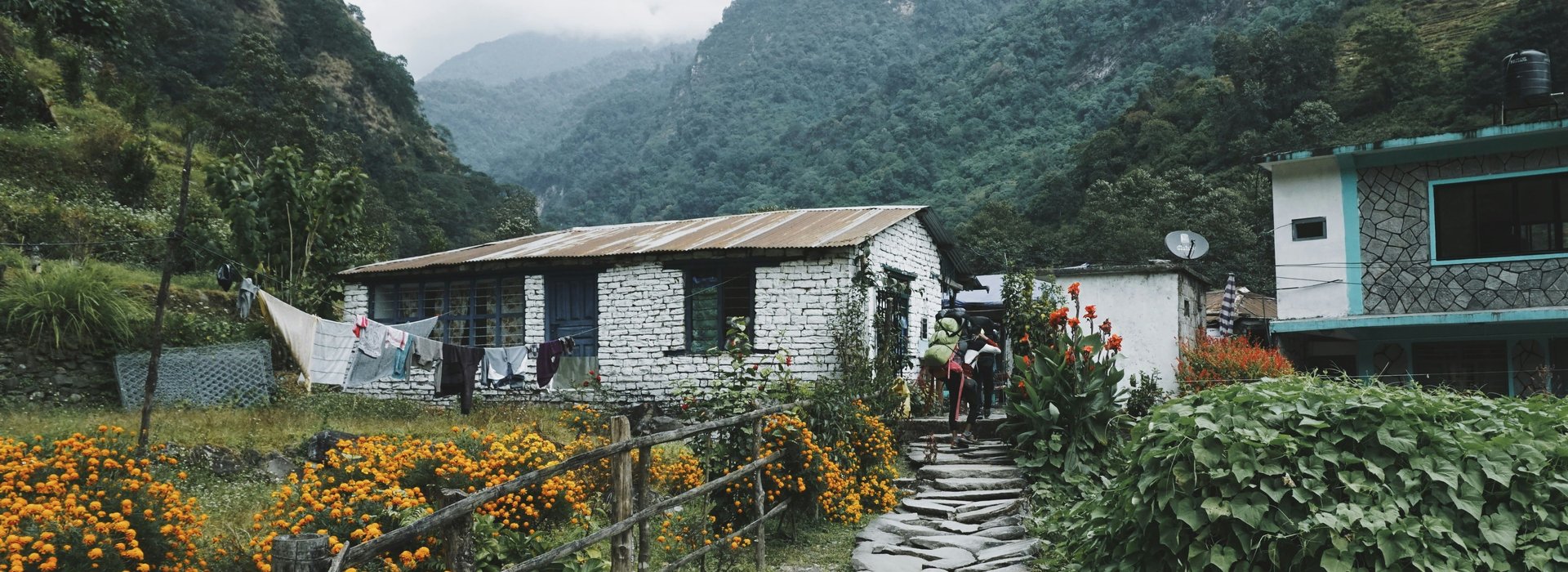
The tea houses on the Manaslu Circuit are not luxury lodges — and knowing that before you go is part of what makes the experience so rewarding. This is a restricted-area trek through one of Nepal's most remote river valleys, and the accommodation reflects that. It is basic, genuine, warm, and unlike anything available on Nepal's more developed trekking corridors.
This guide tells you exactly what to expect at every major village on the route, so you arrive with accurate expectations and the right gear rather than surprises.
Quick Answer: What Are Manaslu Circuit Trek Tea Houses Like?
Tea houses on the Manaslu Circuit Trek are basic, family-run mountain guesthouses offering simple twin-bed rooms, shared bathrooms, and communal dining halls. Facilities improve below 3,000 m and become increasingly basic above Namrung. Samagaun offers the widest accommodation choice at high altitude. WiFi is limited and unreliable above Jagat. Hot showers are available at lower villages for a small fee. Rooms cost USD 3–12 per night depending on altitude and village.
What Is Tea House Trekking in Nepal?
Tea house trekking is Nepal's defining trekking style — a system of family-run mountain guesthouses spaced at each village along a trekking route, providing a bed, hot food, and basic facilities to trekkers without requiring tents or camping equipment.
The term "tea house" comes from the original function of these stops as resting points where travelers drank butter tea or local chai between villages. Over decades, they evolved into full guesthouses — the backbone of Nepal's entire trekking industry.
- Tea houses are family-run; the family typically lives on site
- Rooms are simple: twin beds, thin mattresses, minimal furniture
- A communal dining hall is the social centre of each tea house
- Meals are freshly cooked to order — not buffet-style
- The lodge rule is standard: guests are expected to eat at the lodge where they sleep
- Tea house quality varies significantly by altitude and trail development level
On the Manaslu Circuit, tea house trekking takes on a more remote character than on the Annapurna or Everest routes. The restricted-area permit system that limits visitor numbers also limits the commercial pressure that drives infrastructure investment on more popular trails. The result is a more authentic, culturally intact experience — with trade-offs in comfort that every trekker should understand before departing.
Manaslu Circuit Tea Houses vs Other Nepal Treks
Before diving into specifics, it helps to understand where Manaslu sits on the comfort spectrum of Nepal's major trekking routes.
- Everest Base Camp / Annapurna Circuit — Most developed; private en-suite rooms available at major stops; reliable WiFi to 4,000 m; hot showers standard
- Langtang Valley — Moderately developed; basic but clean; facilities improve at Kyanjin Gompa
- Manaslu Circuit — Less developed than EBC/ABC; genuinely remote above Namrung; basic facilities from Samagaun upward
- Tsum Valley / Upper Mustang — Even more remote; fewer options; Manaslu is more comfortable by comparison
- Manaslu advantage — Quieter, cheaper, more culturally intact than EBC or Annapurna
This context matters because trekkers arriving with Annapurna-level expectations at Dharamsala (4,460 m) will be genuinely surprised. Trekkers who prepare for genuine mountain remoteness will find the tea houses perfectly adequate and the cultural experience exceptional.
Room Types and Sleeping Arrangements
Most tea houses on the Manaslu Circuit offer twin-bed private rooms. Below 3,000 m, private attached bathrooms are available at better lodges. Above Namrung, rooms are almost universally twin-bed with shared squat toilets.
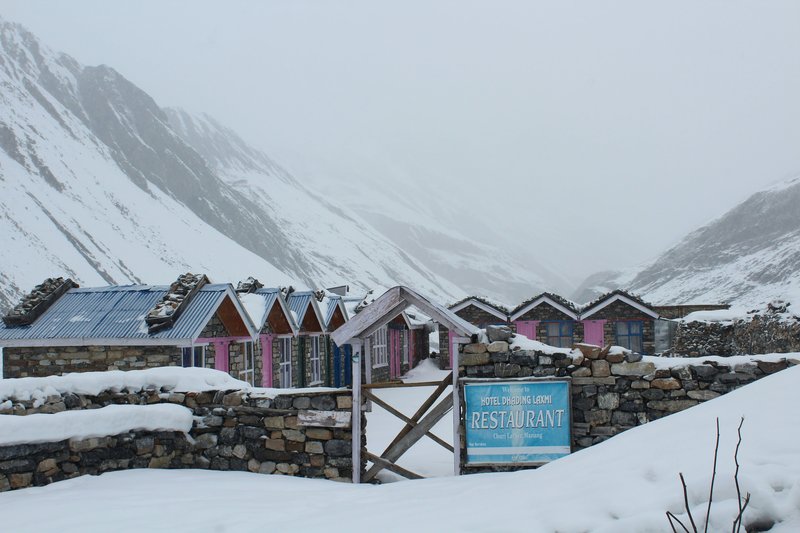
At Dharamsala — the highest overnight stop at 4,460 m before the Larkya La pass crossing — accommodation is the most basic on the entire route. Expect dormitory-style sleeping in some lodges, thin walls between rooms, and minimal insulation. The cold at 4,460 m enters the room; a quality sleeping bag is not optional.
- Lower villages (below 2,000 m) — Private rooms standard; some attached bathrooms; most comfortable nights of the trek
- Mid-altitude villages (2,000–3,500 m) — Private twin rooms standard; shared bathroom blocks; improving in Samagaun
- High altitude (above 3,500 m, Samdo and above) — Basic twin rooms; shared facilities; dormitory possible at Dharamsala
- Bedding — Blankets provided but bring a -10°C sleeping bag for above 3,500 m; -20°C rated bag for winter months
- Privacy — Walls are thin; wood or stone partition construction is standard above 3,000 m
Food and Dining on the Manaslu Circuit
Tea house menus on the Manaslu Circuit package are surprisingly varied at lower elevations and progressively simpler as altitude increases. Below Namrung, most lodges offer 30–50 item menus including dal bhat, pasta, fried rice, eggs, pancakes, soups, and local Tibetan dishes. Above Samagaun, the menus narrow significantly.
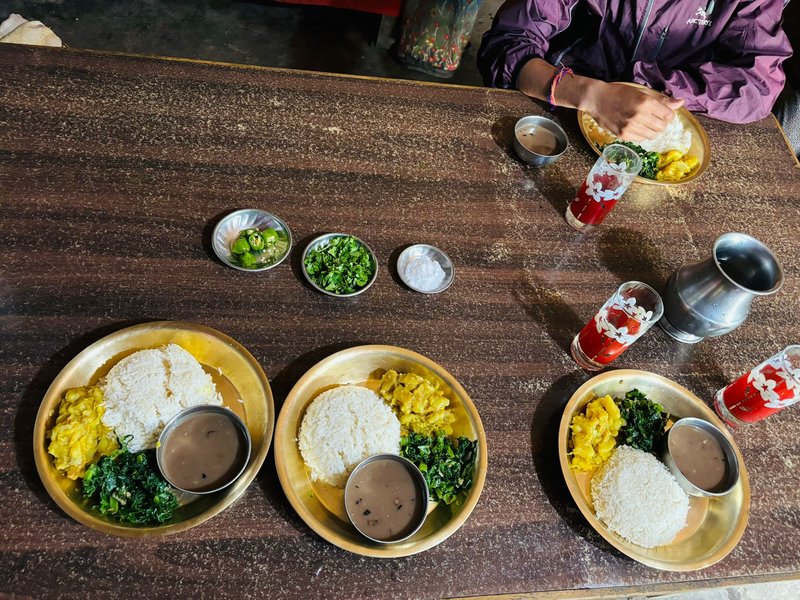
Dal Bhat is the single most important food choice at every altitude. It is freshly cooked, high in carbohydrates, filling, and comes with free refills — making it the most calorie-efficient meal available on any Nepal trekking route. At high altitude above 3,500 m, it is almost always the best-prepared item on the menu.
- Dal Bhat — the trail staple; free refills; available at every village
- Noodle soups and pasta — widely available below 3,500 m
- Tibetan dishes — tsampa porridge, Tibetan bread, butter tea — increasingly common above Deng
- Eggs and pancakes — available at most villages below Samagaun
- High-altitude note — above Samdo, menus shrink to 5–8 items; carbohydrate dishes only
- Dining hall culture — the communal dining room with a central stove is where trekking groups socialise in the evenings
Vegetarian meals are recommended above 3,500 m — meat storage in remote high-altitude tea houses is unreliable, and digestive disruption at altitude has serious implications for acclimatization. This is not a preference suggestion; it is a practical health recommendation from Himalayan trekking experience.
Bathrooms, Showers, and Hygiene
Hot showers are available at most lower-altitude villages on the Manaslu Circuit — typically solar-heated water in a basic cubicle, costing NPR 200–400 (approximately USD 2–3) per use. Above Namrung, hot showers become less reliable and above Samagaon are either cold or unavailable.
Western-style flush toilets are standard at better lodges below 3,000 m. Squat toilets with bucket-flush arrangements are the norm at higher altitudes. At Dharamsala, toilet facilities are minimal — an outdoor squat arrangement with limited privacy is standard. This is not exceptional by Himalayan trekking standards, but it requires adjustment for first-time high-altitude trekkers.
- Hot showers: available at Machha Khola, Jagat, Deng, and Namrung for USD 2–3
- Hot showers above Namrung: limited and unreliable; cold showers only above Samagaun
- Western flush toilets: available at better lodges below 3,000 m
- Squat toilets: standard from Namrung upward
- Toilet facilities at Dharamsala: outdoor squat only; bring hand sanitiser
- Washing facilities: bring wet wipes and a small travel towel for above 4,000 m
WiFi, Charging, and Connectivity
WiFi availability on the Manaslu Circuit is limited and should not be relied upon above Jagat. Lower villages like Machha Khola and Jagat have basic WiFi in dining halls — slow, congested during peak season, but functional for messaging. Above Deng, connectivity drops significantly. Samagaun has limited satellite-based WiFi in some lodges, but speed is extremely low.
Phone charging is available at tea house dining halls throughout the route — for a fee of NPR 200–300 (USD 2–3) per device. At Dharamsala and Samdo, charging depends on solar panel availability and is not guaranteed. Always charge devices at the previous night's lodge before reaching higher altitudes.
- WiFi available: Machha Khola, Jagat — slow but functional
- WiFi limited: Deng, Namrung — available in some lodges; unreliable
- WiFi effectively unavailable: Samagaun, Samdo, Dharamsala, Bhimthang
- Phone charging: available throughout route in dining halls; USD 2–3 per device
- Charging at high altitude (Samdo, Dharamsala): solar-dependent; not guaranteed
- Recommendation: download offline maps, guides, and entertainment before leaving Kathmandu; bring a power bank (10,000 mAh minimum)
Village-by-Village Accommodation Guide
Machha Khola (870 m)
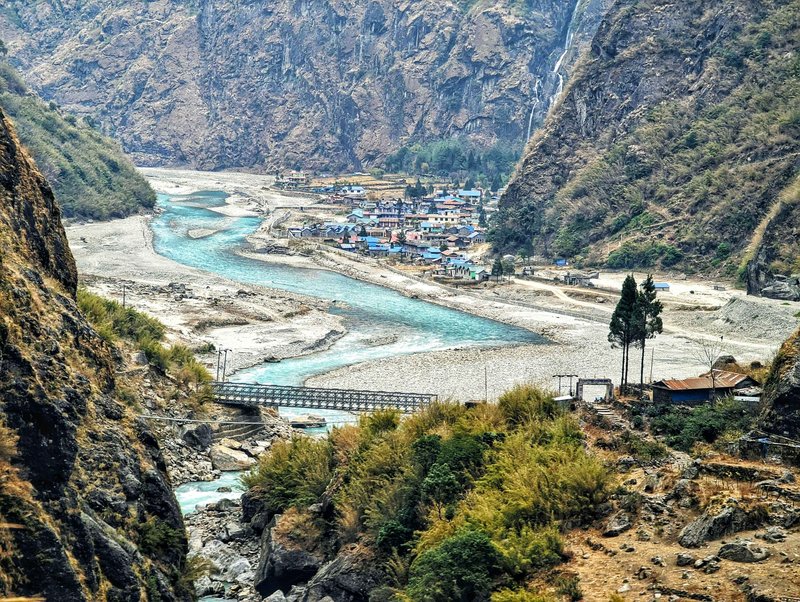
The first overnight stop after Sotikhola, Machha Khola sits in the subtropical lower Budhi Gandaki valley. Tea houses here are among the most comfortable on the entire route — warm nights, private rooms, basic attached bathrooms available at better lodges, and hot showers. Menus are varied. It is a gentle introduction to tea house trekking.
- Accommodation: comfortable; private rooms standard; some attached bathrooms
- Facilities: hot showers, WiFi, phone charging, flush toilets
- Food variety: wide menu; eggs, dal bhat, pasta, pancakes
- Room cost: USD 3–5 per night
- Best for: first night settling in before the route climbs
Jagat (1,410 m)
Jagat is the first official restricted-area checkpoint, where permits are verified for the first time. The village marks the transition into the controlled Manaslu zone and is a natural overnight stop with good tea house options. Accommodation is comfortable at this elevation — better than most villages above it.
- Accommodation: good quality; private rooms with shared bathroom blocks
- Facilities: WiFi (limited), hot showers, phone charging
- Permit check: mandatory; carry all original permit documents
- Room cost: USD 3–5 per night
- Food variety: full menu available
Deng (1,860 m)
Deng is a small village that marks the route's transition from lower subtropical terrain toward the temperate forest zone. Tea houses are basic but adequate. The village is quieter and less developed than Jagat — a characteristic that defines the increasingly remote character of the route above.
- Accommodation: basic private rooms; shared bathrooms
- Facilities: limited WiFi, hot showers possible, phone charging
- Room cost: USD 3–5 per night
- Atmosphere: genuinely quiet; few trekkers at any time of year
Namrung (2,630 m)
Namrung is often described as the last reliably comfortable overnight stop before the high-altitude section of the route. Several well-established lodges serve trekkers here, and the village has enough traffic to maintain reasonable facilities. Hot showers are available but less reliable than lower villages.
- Accommodation: comfortable by mid-route standards; good lodge selection
- Facilities: hot showers (limited), phone charging, limited WiFi
- Room cost: USD 5–7 per night
- Special note: good acclimatization stop before the push toward 3,500 m
Lho (3,180 m)
Lho is a small village with a spectacular position — the first place on the route where Manaslu (8,163 m) becomes dramatically visible above the valley. Accommodation is basic, with a small number of lodges. Lho is sometimes bypassed in favour of continuing to Samagaun, but its views and quieter atmosphere make it worth an overnight stop.
- Accommodation: basic twin rooms; limited lodge selection
- Facilities: phone charging (solar); hot showers unlikely; no WiFi
- Room cost: USD 5–7 per night
- Highlight: first clear view of Manaslu summit from the village
Samagaun / Sama Gaon (3,530 m)
Samagaun is the accommodation hub of the upper Manaslu Circuit. As the main acclimatisation village before the Larkya La crossing, it has the best tea house selection above 3,000 m on the entire route. Several lodges here are genuinely well-maintained by Manaslu standards — stone-built, with proper insulation, central heating in dining halls, and reasonable food menus.
- Accommodation: best selection above 3,000 m; 6–8 lodges available
- Facilities: phone charging, limited WiFi at some lodges, cold showers only
- Food: best high-altitude menu on the route; dal bhat, pasta, Tibetan dishes
- Room cost: USD 7–10 per night
- Acclimatisation rest day: spending an extra night here significantly improves pass-crossing safety
Samdo (3,860 m)
Samdo is a small Tibetan-origin village near the Tibetan border — culturally one of the most distinctive stops on the route. Accommodation is basic, with a handful of tea houses and limited facilities. The village retains a strong traditional character with minimal trekking infrastructure compared to Samagaun.
- Accommodation: basic twin rooms; 3–4 lodges available
- Facilities: solar charging (weather-dependent); no WiFi; cold water only
- Room cost: USD 7–10 per night
- Cultural note: Tibetan-influenced architecture, Buddhist monasteries, and yak herding community
Dharamsala / Larkya Phedi (4,460 m)
Dharamsala is the most basic accommodation on the entire Manaslu Circuit. It exists solely as a pre-pass camp — trekkers stay here to minimise the following day's ascent to Larkya La (5,106 m/5,160 m). Expect very basic shelter: thin-walled rooms, minimal heating, cold or no water, and a single simple dining hall.
- Accommodation: most basic on route; dormitory-style rooms at some lodges
- Facilities: solar charging only (weather-dependent); no WiFi; no hot water
- Room cost: USD 10–12 per night (premium for altitude and remoteness)
- Sleeping bag rating required: minimum -15°C; -20°C recommended
- Critical note: arrive early afternoon; rest, eat carbohydrates, sleep by 8 PM for 3–4 AM departure
Bhimthang (3,720 m)
After crossing the Larkya La Pass, Bhimthang is the first overnight stop on the descent — and many trekkers describe it as one of the most emotionally rewarding sleeps of the trek. The village is beautifully situated in a wide alpine meadow, and the relief of completing the pass crossing makes even basic facilities feel luxurious by comparison.
- Accommodation: basic but adequate; better than Dharamsala
- Facilities: phone charging, basic food menu, cold water
- Room cost: USD 7–10 per night
- Atmosphere: post-pass euphoria; spacious meadow setting; Manaslu views
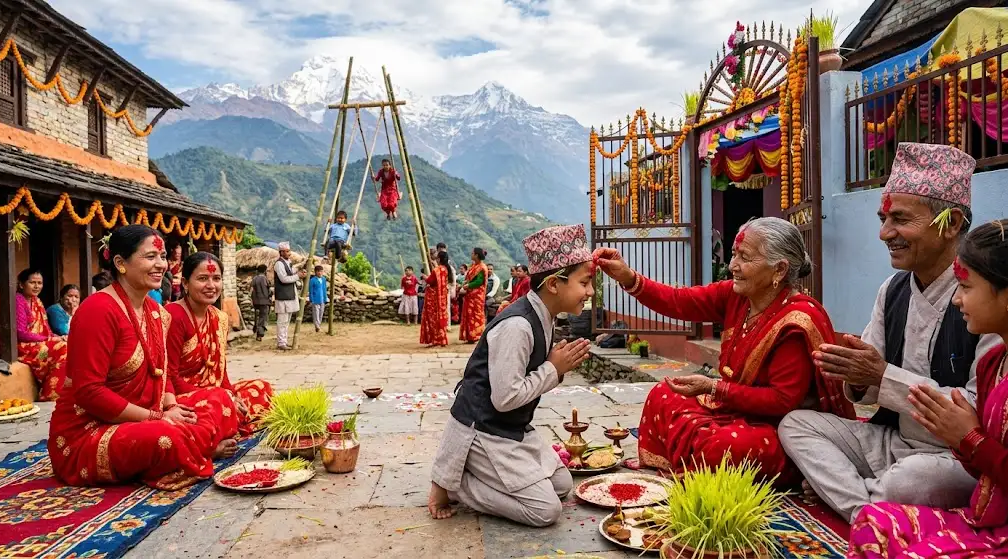
The cultural reality exceeds most expectations. The family-run nature of Manaslu tea houses means you are sleeping in someone's home, eating food prepared by a local family, and contributing directly to community livelihoods. This human element — absent from hotel trekking — is the defining character of the Manaslu tea house experience.
Do You Need to Book Tea Houses in Advance?
In peak season (October–November and March–May), advance booking for Samagaun and Dharamsala is strongly recommended. These two villages have limited bed capacity — Samagaun's 6–8 lodges serve the entire high-altitude acclimatisation demand, and Dharamsala's handful of basic shelters fill early on busy trail days.
Your guide (mandatory on the Manaslu Circuit) will typically manage lodge reservations through their trail network. This is one of the practical reasons having an experienced local guide — rather than attempting self-navigation — materially improves your trek logistics.
- Peak season (Oct–Nov, Mar–May): advance booking essential for Samagaun and Dharamsala
- Off-season (Dec–Feb, Jun–Aug): walk-in availability is generally fine
- Booking mechanism: guides manage through WhatsApp or phone networks with lodge owners
- No online booking system exists for Manaslu Circuit tea houses
- Last-minute arrivals at Dharamsala in October can face dormitory-only availability
For trekkers booking through Himalayan Hero Adventures, lodge reservations along the route are managed by the guide as part of the guided Manaslu Circuit package — eliminating the accommodation uncertainty entirely.
Essential Packing for Tea House Trekking on Manaslu
Knowing what the tea houses provide — and what they don't — is the framework for packing correctly.
What tea houses provide: basic bedding (blankets), meals to order, hot water for tea, basic first aid referral, and local knowledge from your host family.
What tea houses do NOT reliably provide above 3,000 m: personal sleeping warmth, electricity on demand, hot water for washing, WiFi, and Western toilet facilities.
- Sleeping bag — rated -10°C minimum for autumn/spring; -20°C for winter above 3,500 m
- Power bank — 10,000–20,000 mAh; charged fully in Kathmandu before departure
- Offline content — download maps (Maps.me or Gaia GPS), books, and podcasts before leaving Kathmandu
- Wet wipes — essential above Namrung where shower access becomes unreliable
- Headlamp — 3 AM Dharamsala start requires a reliable headlamp with spare batteries
- Water purification — tablets or SteriPen; buying bottled water above Samagaun is expensive and environmentally damaging
- Earplugs — thin walls and early-rising trekking groups are universal above 3,000 m
Tips for Getting the Most from Manaslu Tea Houses
Small behavioural choices make a significant difference to both your experience and your relationship with the local community.
Eat at your lodge. The lodge-rule exists for economic reasons that sustain the community. Eating elsewhere while occupying a room creates friction and undermines the business model that keeps these lodges operating in remote high-altitude villages.
Tip fairly and directly. Lodge owners and their families receive minimal income per room. A 10–15% tip on your food bill, given directly to the family member who cooked and served you, is appropriate and valued.
Bring exact change. Small notes (NPR 100, 500) are essential above Jagat — lodge owners rarely have change for large bills, and ATMs do not exist beyond Arughat.
- Eat at your lodge — always; this is both etiquette and economic responsibility
- Tip directly to the family member who served you
- Carry NPR 100 and NPR 500 notes; no ATMs above Arughat
- Close the dining hall door behind you — heat loss affects everyone in the room
- Ask permission before photographing inside lodges or of family members
- Learn two or three Nepali phrases — Namaste, Dhanyabad (thank you), Bistari (slowly) — it matters
Frequently Asked Questions
Are tea houses available throughout the Manaslu Circuit?
Yes — tea houses are available at every major overnight village from Machha Khola to Bhimthang. Quality and facilities decrease with altitude. The most basic accommodation is at Dharamsala (4,460 m), which offers minimal shelter before the Larkya La crossing. Trekkers should never plan to wild-camp when tea houses are available — it disrupts local economics and requires permit registration updates.
Do Manaslu Circuit tea houses have private rooms?
Yes — private twin-bed rooms are available at all villages from Machha Khola through Bhimthang. Above Samagaun, room quality decreases and dormitory-style sleeping may be the only option at Dharamsala during peak season. Attached private bathrooms are available at better lower-altitude lodges only.
Is WiFi available on the Manaslu Trek?
Reliably only at lower villages — Machha Khola and Jagat. Above Deng, WiFi becomes limited and unreliable. Above Namrung, it is effectively unavailable. Trekkers should download all maps, guides, and offline content before departing Kathmandu and carry a fully charged power bank.
Are hot showers available on the Manaslu Circuit?
Yes, at lower villages (Machha Khola, Jagat, Deng, Namrung) for approximately USD 2–3. Above Namrung, hot showers become unreliable. Above Samagaun, only cold water is available. At Dharamsala and Samdo, no shower facilities exist. Pack wet wipes and a travel towel for the upper section.
What food is served in Manaslu Circuit tea houses?
Dal bhat (rice and lentils) is available at all villages and remains the best meal choice throughout the route. Below 3,500 m, menus typically include pasta, fried rice, soups, noodles, eggs, and Tibetan dishes. Above Samagaun, menus simplify to 5–8 carbohydrate-based dishes. Vegetarian meals are recommended above 3,500 m.
How much does accommodation cost on the Manaslu Circuit?
Room prices range from USD 3–5 at lower villages (Machha Khola, Jagat) to USD 10–12 at Dharamsala. Mid-route villages (Namrung, Samagaun) charge USD 5–10 depending on lodge quality. Most tea houses operate on the lodge-rule model — guests eat at the lodge where they sleep.
Which village has the best tea houses on the Manaslu Circuit?
Samagaun (3,530 m) has the best high-altitude accommodation on the route, with 6–8 lodges, the widest food menu above 3,000 m, phone charging, and some WiFi availability. At lower elevations, Jagat (1,410 m) and Machha Khola (870 m) offer the most comfortable nights of the trek.
Do I need to book tea houses in advance?
In peak season (October–November and March–May), advance booking is strongly recommended for Samagaun and Dharamsala. Your guide manages reservations through trail networks. Off-peak trekkers can generally walk in without prior booking. No online booking system exists for Manaslu Circuit tea houses.