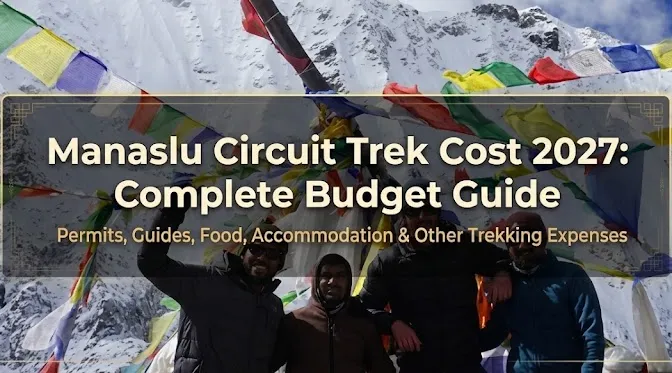
The Manaslu Circuit Trek requires a Restricted Area Permit (RAP), Manaslu Conservation Area Permit (MCAP), Annapurna Conservation Area Permit (ACAP), and the Chumnubri Rural Municipality fee. The total Manaslu Circuit Trek permit cost depends mainly on the trekking season and duration of the restricted-area permit, with additional fees applying if you include Tsum Valley.
| Permit / Fee |
Issued by |
Cost |
Where Paid |
| Manaslu Restricted Area Permit (RAP) |
Department of Immigration |
Depends on season and number of days |
Kathmandu, through a registered trekking agency |
| Manaslu Conservation Area Permit (MCAP) |
Nepal Tourism Board / conservation authority |
Fixed permit fee |
Kathmandu or through trekking agency |
| Annapurna Conservation Area Permit (ACAP) |
Nepal Tourism Board / conservation authority |
Fixed permit fee |
Kathmandu or through trekking agency |
| Chumnubri Rural Municipality Fee |
Chumnubri Rural Municipality |
Local fee |
Usually arranged through the trekking agency |
| Tsum Valley Restricted Area Permit |
Department of Immigration |
Depends on season and number of days |
Kathmandu, through a registered trekking agency |
Why Does the Manaslu Circuit Trek Need 4 Permits?
The Manaslu Circuit Trek needs four main permits or fees because the route passes through a restricted border area, the Manaslu Conservation Area, the Annapurna Conservation Area, and Chumnubri Rural Municipality. The Manaslu Restricted Area Permit (RAP) is required for the restricted section and is issued through the Department of Immigration. You also need the Manaslu Conservation Area Permit (MCAP) and Annapurna Conservation Area Permit (ACAP) for the conservation areas. The Chumnubri Rural Municipality fee is a separate local charge, so it is not included in the RAP or conservation permits.
This is why the term “Manaslu permit” can be confusing when people search for the Manaslu Circuit Trek permit cost. There is no single permit covering the whole trek. The main charges are the Manaslu special permit (RAP), MCAP, ACAP, and Chumnubri permit. If you plan to add the Tsum Valley to your itinerary, you will also need a separate Tsum Valley restricted area permit, which increases the total Manaslu Circuit + Tsum Valley permit cost.
What Are the 4 Permits for the Manaslu Circuit Trek?
The Manaslu Circuit Trek does not use one single permit for the whole route. You need different permits and fees because the trek passes through a restricted area, the Manaslu Conservation Area, the Annapurna Conservation Area, and Chumnubri Rural Municipality. Knowing what each permit covers makes it much easier to calculate your total Manaslu Circuit Trek permit cost and avoid surprises during the trek.
The four main charges are the Manaslu Restricted Area Permit (RAP), Manaslu Conservation Area Permit (MCAP), Annapurna Conservation Area Permit (ACAP), and Chumnubri Rural Municipality fee. Their costs and requirements are different, and if you add Tsum Valley to your itinerary, you will need an additional restricted-area permit for that section.
Restricted Area Permit (RAP)
The Manaslu Restricted Area Permit (RAP) is the main permit for entering the restricted section of the Manaslu region. It is issued through the Department of Immigration and is required for trekkers entering the restricted area. The cost changes according to the trekking season and the number of days you stay inside the restricted section, so there is no single fixed RAP fee.

The guide and group rules around the Manaslu RAP have also had some changes and conflicting information in 2026. Some newer 2026 sources report that the previous minimum two-person rule was dropped from March 2026, allowing solo trekkers to enter with a licensed guide, while some agency policies may still follow the older requirement. Because of this conflict, confirm the current rule with your registered trekking agency before your trek.
Manaslu Conservation Area Permit (MCAP)
The Manaslu Conservation Area Permit (MCAP) is required because the Manaslu Circuit passes through the Manaslu Conservation Area. The fee is NPR 3,000 for foreign trekkers and NPR 200 for SAARC nationals. This is a separate charge from the Manaslu Restricted Area Permit.

The MCAP supports conservation and management work in the Manaslu Conservation Area. In most cases, your trekking agency arranges this permit along with the RAP and other required documents before you begin the trek.
Annapurna Conservation Area Permit (ACAP)
The Annapurna Conservation Area Permit (ACAP) is required because the standard Manaslu Circuit route exits through Dharapani, which is inside the Annapurna Conservation Area. The fee for foreign trekkers is NPR 3,000, which is roughly around $20–30 depending on the exchange rate.
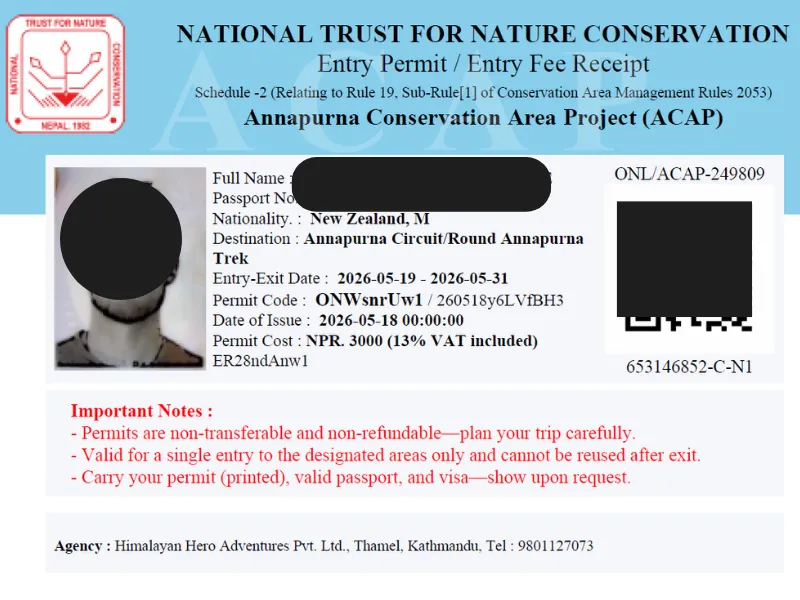
ACAP is easy to miss when calculating the Manaslu permit fee because the trek is usually called the Manaslu Circuit. But the route crosses into another conservation area near the end, so ACAP needs to be included in your total permit budget.
Chumnubri Rural Municipality Fee
The Chumnubri Rural Municipality fee is a local charge that many older Manaslu trekking blogs do not mention. It is separate from the RAP, MCAP and ACAP and is connected with trekking through Chumnubri Rural Municipality. The fee is commonly reported at around NPR 1,000–2,000, or roughly $8–15, but trekkers should confirm the current amount for 2026.
The fee may be collected in cash at the Jagat checkpoint, so do not depend on card payment facilities along the trail. The money goes toward local needs such as trail and bridge maintenance and waste management. Because this is a newer fee and is missing from many older articles, checking the current Chumnubri permit requirement with your trekking agency before departure is a good idea.
What Is the Manaslu Restricted Area Permit Cost?
The Manaslu Restricted Area Permit (RAP) is required for trekking in the controlled sections of the Manaslu region and Tsum Valley. The fee is based on the season and the number of days you spend inside the restricted area. This is separate from the Manaslu Conservation Area Permit (MCAP), Annapurna Conservation Area Permit (ACAP), and Chumnubri Rural Municipality fee, which are added when calculating the full permit cost of your trek.
Manaslu Restricted Area Permit Fees
The Manaslu Restricted Area Permit (RAP) is required for both the Manaslu Circuit Trek and theManaslu Base Camp Trek when the itinerary enters the Manaslu restricted area. The cost depends on the season and the number of days spent in the restricted section.
| Trek / Restricted Area |
Season |
First 7 Days |
Each Extra Day |
| Manaslu Circuit Trek / Manaslu Base Camp Trek |
September to November |
USD 100/person/week |
USD 15/person/day |
| Manaslu Circuit Trek / Manaslu Base Camp Trek |
December to August |
USD 75/person/week |
USD 10/person/day |
| Tsum Valley |
September to November |
USD 40/person/week |
USD 7/person/day |
| Tsum Valley |
December to August |
USD 30/person/week |
USD 7/person/day |
Tsum Valley Restricted Area Permit
The Tsum Valley Restricted Area Permit is separate from the Manaslu RAP. It is required if you include Tsum Valley in aManaslu Tsum Valley Trek, covering the restricted route through places such as Sirdibas, Lokpa, Chumling, Chekampar, Nile and Chule.
The Tsum Valley permit costs USD 40 per person for the first 7 days from September to November, with USD 7 per extra day. From December to August, it costs USD 30 for the first 7 days, followed by USD 7 per extra day.
So, if you are planning the Manaslu Circuit Trek only, calculate the Manaslu RAP according to your dates and number of days. If you add Tsum Valley, its restricted-area permit is an additional cost and should not be confused with the main Manaslu permit.
How Much Do All 4 Manaslu Trek Permits Cost?
The total Manaslu Circuit Trek permit cost depends mainly on the season and the number of days you spend in the restricted area. The MCAP is NPR 3,000, ACAP is NPR 3,000, and the Chumnubri fee is NPR 1,000, which together are roughly $49–52, depending on the exchange rate. These figures are for permits only, not the full cost of the Manaslu Circuit Trek. If you also include Tsum Valley, its separate restricted-area permit will be added to your total. The table below gives a simple estimate in US dollars
Manaslu Circuit Trek Permit
| RAP Duration |
Season |
RAP |
MCAP + ACAP + Chumnubri |
Estimated Total |
| 7 days |
September–November |
$100 |
~$49–52 |
~$149–152 |
| 12 days |
September–November |
$175 |
~$49–52 |
~$224–227 |
| 14 days |
September–November |
$205 |
~$49–52 |
~$254–257 |
| 7 days |
December–August |
$75 |
~$49–52 |
~$124–127 |
| 12 days |
December–August |
$125 |
~$49–52 |
~$174–177 |
| 14 days |
December–August |
$145 |
~$49–52 |
~$194–197 |
Manaslu + Tsum Valley Permit Cost
| RAP Duration |
Season |
Manaslu + Tsum Valley RAP |
MCAP + ACAP + Chumnubri |
Estimated Total |
| 7 days |
September–November |
$140 |
~$49–52 |
~$189–192 |
| 12 days |
September–November |
$235 |
~$49–52 |
~$284–287 |
| 14 days |
September–November |
$279 |
~$49–52 |
~$328–331 |
| 7 days |
December–August |
$105 |
~$49–52 |
~$154–157 |
| 12 days |
December–August |
$190 |
~$49–52 |
~$239–242 |
| 14 days |
December–August |
$224 |
~$49–52 |
~$273–276 |
The Tsum Valley Restricted Area Permit (RAP) costs $40 per person for the first 7 days from September to November and $30 per person for the first 7 days from December to August. After 7 days, an additional $7 per person per day is charged in both seasons.
Note: These are estimated permit costs only. The Manaslu RAP and Tsum Valley RAP are calculated separately based on the number of days spent in each restricted area. The $49–52 includes MCAP, ACAP, and the $7–8 Chumnubri Rural Municipality fee.
What Is the Manaslu Permit Cost for Indian and SAARC Nationals?
Indian trekkers and other SAARC nationals should know that not every Manaslu permit has a reduced price. The MCAP and ACAP have lower rates for SAARC nationals, but the Manaslu Restricted Area Permit (RAP) is charged at the regular rate. The Chumnubri Rural Municipality fee is also separate and should be included in the total permit budget.
| Permit |
SAARC / Indian Rate |
Foreign Rate |
| Manaslu Restricted Area Permit (RAP) |
Same RAP rate |
$100/week in Sept–Nov; $75/week in Dec–Aug |
| MCAP |
NPR 1000 |
NPR 3,000 |
| ACAP |
NPR 1,000 |
NPR 3,000 |
| Chumnubri Rural Municipality Fee |
NPR 1,000 |
NPR 1,000 |
For an Indian trekker, the lower SAARC rates mainly reduce the conservation-area permit costs. You still need the required RAP at the applicable seasonal rate, along with the Chumnubri fee. If you also add Tsum Valley, its separate restricted-area permit is charged in the same way according to the applicable season and duration.
How Do You Get the Manaslu Circuit Trek Permits?
Getting the Manaslu Circuit Trek permits is straightforward, but the Restricted Area Permit has stricter requirements. The RAP must be arranged through a registered trekking agency, while MCAP and ACAP can generally be obtained separately. It is best to arrange everything before leaving Kathmandu and keep one extra day as a buffer in case of office closures or delays.
Permit Process
- Prepare your documents: Keep a passport copy, passport-size photos, trekking itinerary, and other details requested by the permit office or agency.
- Arrange the RAP through an agency: The Manaslu Restricted Area Permit cannot be obtained independently. A registered trekking agency handles the application through the Department of Immigration.
- Get MCAP and ACAP: These conservation permits can generally be arranged yourself or through your trekking agency. Most trekkers choose the agency option because it keeps all permits together.
- Allow extra time: Do not leave permit arrangements until the last minute. Keep a buffer day in Kathmandu, especially if your schedule is tight, because the immigration office is closed on weekends and processing can take time.
- Pay the Chumnubri fee on the trail: The Chumnubri Rural Municipality fee is separate from the Kathmandu permits. It is paid at the relevant checkpoint along the Manaslu route, so keep some Nepalese cash with you.
For a Manaslu Circuit Trek, your agency can normally arrange the required permits before you start walking. If you are also doing Tsum Valley, make sure the separate Tsum Valley Restricted Area Permit is included in your permit plan.
Do You Need a Registered Trekking Company and Guide?
Yes. The Manaslu Circuit Trek requires a registered trekking company and a licensed guide because the route enters a restricted area. Solo trekking is now allowed in the Manaslu restricted area with a licensed guide through a registered trekking agency. This means you can trek without another trekking partner, but you still need the required agency and guide arrangement for the RAP.
Ready for Your Manaslu Adventure? Get Your Permits Sorted Before You Go
Himalayan Hero is a Nepal-based trekking company with more than 15 years of experience arranging Himalayan adventures. Our local team can help you arrange the RAP, MCAP, ACAP, and Chumnubri fee, check the current permit requirements, and provide a licensed guide for your Manaslu trek.
If Manaslu is on your list for the coming season, it is better to sort out your permits, guide, and itinerary early, especially during the busy September to November period. Contact Himalayan Hero today to check your Manaslu Circuit Trek options and start planning your journey with a local team that knows the route.
Frequently Asked Questions About Manaslu Trek Permits
How Much Does a Manaslu Circuit Trek Cost?
The cost depends on the trek duration, permits, guide, accommodation, meals, and transport. See our Manaslu Circuit Trek Cost and Itinerary for a detailed breakdown.
What Should I Pack for the Manaslu Circuit Trek?
Pack warm layers, trekking boots, a waterproof jacket, sleeping bag, gloves, sunglasses, sunscreen, water bottle, and personal medicines. Check our Manaslu Circuit Trek Packing List for the full list.
Is the Manaslu Circuit Trek Difficult?
Yes, it is a challenging trek due to long walking days, high altitude, remote terrain, and the 5,106-meter Larkya La Pass. Read our guide to Manaslu Circuit Trek Difficulty for more details.
What Is the Best Time to Visit Manaslu?
October is one of the best months, with stable weather, clear skies, and good mountain views. September, November, and spring are also good options.
Do I Need a Guide for the Manaslu Circuit Trek?
Yes. The trek requires a registered trekking company and a licensed guide because it passes through a restricted area. Solo trekking is allowed with a registered guide.
What Permits Are Required for the Manaslu Circuit Trek?
You need the RAP, MCAP, ACAP, and Chumnubri Rural Municipality fee. A separate restricted-area permit is required if you add Tsum Valley.